

01、雅思听力 Listening
本次考试题型组合难度较大,其中 Part 2 及 Part 3 均为多选与配对的组合。比起单选,多选的信息量更大、干扰项更多,整体难度有上升。建议近期备考的同学加强多选的练习,尤其是多选与配对组合的篇目练习。推荐练习:剑19 T1 S3、剑18 T3 S3、剑17 T4 S3
Part 1 成人学习小组
【题型】: 填空
点评
场景为常规活动咨询场景,答案词中注意 dictionary、competition 的拼写。此外,较长数字的拼写也需要熟练,建议同学们加强数字,尤其是长串号码的听写训练,做到反应迅速、准确。
1. 30
2. high
3. lunch
4. 07765469251
5. library
6. dictionary
7. bowling
8. competition
9. school
10. painting
(答案仅供参考,实际答案及顺序可能有变化)
Part 2 公园活动
【题型】:多选+配对
点评
该篇目话题较为常规,但题型组合难度较高。多选题在信息量和密度上均显著高于单选题,同学们要注意选项的快速定位及跳转,同时把握细节信息的同替对应。连续多道多选的题目中,更要注意题干的定位。
11-12. BD
13-14. AD
15-16. CD
17. G
18. F
19. E
20. C
(答案仅供参考,实际答案及顺序可能有变化)
Part 3 骨骼及起源
【题型】:多选+配对
点评
该篇练习话题难度较大,在背景上存在一定理解难度。日常备考需要多补充相关学术语料,熟悉 presentation 场景可能出现的表达。其中,配对题对信息梳理能力要求较高,且对话中可能存在较多干扰选项表达,练习时建议重点关注转折表达排除干扰。
21-22. CE
23-24. AE
25. D
26. G
27. E
28. H
29. F
30. C
(答案仅供参考,实际答案及顺序可能有变化)
Part 4 新西兰松果菊
【题型】:填空
点评
Part 4 为生物类学术讲座,属于高频场景,各位同学应该都很熟悉,但仍需要加强学术词汇的拼写,注意如 immune、irrigation 这些容易拼错的难词。同时,也要加强名词单复数的把握。
31. immune
32. flu
33. children
34. flowers
35. climate
36. sand
37. irrigation
38. weeds
39. roots
40. organic
(答案仅供参考,实际答案及顺序可能有变化)

02、雅思阅读 Reading
生物/历史/语言学三连击!7分党看这篇就够了
刚刚考完的烤鸭们,感觉如何?
Passage 1 的“大蜥蜴”是不是送分题?判断题牢记:NG就是原文根本没提!别自己加戏猜尾巴颜色。
Passage 2 硬币史堪称配对题模板!解题关键就一句话:跟着时间线走,抓住材质工艺变变变!遇到Lydia、古希腊专有名词别慌,都是定位神器。
Passage 3 语言变迁杀疯了!判断题+配对+单选套餐专治不服。记住:语言变化五大原因(社会 / 接触 / 简化 / 代际 / 权威)就像万能钥匙,学者观点对立处必出题!
重磅预警:本次考试完美印证“得细节者得天下”规律。生物类(特征-习性-威胁-保护)和历史类(时间-因果-对比)文章结构就是送分指南!下次考试重点复习这类套路!
Pasasage 1 The Tuatare of New Zealand
【难度】:★★★
【题型】:判断6 + 填空7
【话题】:生物
点评
刚刚这篇《新西兰大蜥蜴》阅读,是不是被判断题绕晕了?别急,考情分析来救你!生物类文章结构都像这篇:特征→习性→威胁→保护。先花1分钟看标题、首段和小标题,地图就在心里了。时间不够?重点读首末句子和含数据、转折词的句子!
从题型分布看,本次考试覆盖了雅思阅读两大核心题型:
判断题(TRUE/FALSE/NOT GIVEN):考察细节理解与信息匹配能力,占比约25%;
填空题(笔记填空):侧重定位与原文原词提取,占比约20%。
这两类题型是雅思阅读的“基础分题型”,也是考生必须攻克的重点——正确率需稳定在80%以上,才能冲击阅读7分+。
判断题
1. TRUE
2. FALSE
3. NOT GIVEN
4. FALSE
5. NOT GIVEN
6. TRUE
填空
7. 80
8. Teeth
9. Seabirds
10. Polynesia
11. Mainland
12. Common
13. 2500
(答案仅供参考,实际答案及顺序可能有变化)
参考文章:
The Tuatara of New Zealand
Tuatara are lizard-like reptiles, found only in New Zealand. They are representative of ancient life forms Tuatara are the only living representatives of an ancient lineage of reptiles called Sphenodontia, which is over 250 million years old. Because tuatara still look like fossils of reptiles that lived during the age of dinosaurs, they are often called living fossils. Now just two species of tuatara survive, and only in New Zealand. One is the Brothers Island tuatara which, until recent re-introductions to sanctuaries (safe places for wildlife), only survived on North Brother Island. The other species is the common tuatara, which survives on many other offshore islands. Although the tuatara species appear similar, they have genetic differences. Tuatara bones have been found in many parts of New Zealand. Where dated, they are usually a few hundred to 5,000 years old. It is not known whether these bones are from the two living species or other species that are now extinct.
Many anatomical features distinguish tuatara from other living reptiles - for example, they have a defining pattern of openings in the skull and a unique type of haemoglobin in the blood, and males have no external reproductive organ. Adults are between 30 and 75 centimetres long, and weigh between 250 and 1.200 grams. Males are larger than females, and have more developed spines in the crest along the neck, back and tail.
The male tuatara courts the female by approaching her with a proud walk. Tuatara mate in late summer, and the female usually lays 6-10 eggs the following spring, in a shallow nest at ground level. She may guard the nest for a few nights, then return to her burrow underground. The eggs incubate for about a year, so hatchlings emerge about the time that eggs are being laid the following season. Evidence indicates the gender of tuatara hatchlings is determined by both genetic and environmental factors. It is said that it is more likely for warmer eggs to produce male tuatara, and cooler eggs to produce females. The hatchlings receive no parental care and need to find their own food.
Tuatara live for a relatively long time, reaching reproductive maturity at about 15 years, and may breed for many decades. Their maximum lifespan is not known for certain, but many tuatara have reached 80 years still looking vigorous and healthy. Tuatara live in underground burrows and are more active at night, but will come out during the day to bask in the sun. Both sexes are territorial, and males aggressively defend their territory by posing and fighting if necessary. Teeth are their main weapons, and a bite can cause serious injury. Tuatara are carnivorous, eating invertebrates, lizards and the baby seabirds with which they often share burrows.
Tuatara were once widespread and abundant on the New Zealand mainland, but when Polynesian settlers arrived in New Zealand, in about 1250-1300 AD, they brought with them Pacific rats which killed tuatara. By the time of European settlement, in the 1840s, tuatara were almost extinct on the New Zealand mainland. Some islands provided temporary havens, but soon these too began to be invaded by rats and other mammalian predators.
Gradually tuatara became restricted to 32 nearshore islands. Many of these islands were tiny, some as small as only one hectare. A few, such as the Poor Knights common tuatara lives on islands off the north-eastern coast of New Zealand, and on some islands in Cook Strait. The Brothers Island tuatara survived only on the of the Brothers Island tuatara have been created on Titi Island in the Marlborough Sounds, and on Somes Island in Wellington Harbour.
Tuatara can live in remarkably dense populations. Most tuatara islands have 50- 100 tuatara per square hectare - so an island of only 10 hectares may have a population of hundreds. Larger islands with many seabirds and invertebrates, which tuatara eat, may have greater densities. The largest population is on Stephens Island, where there are estimated to be as many as 2,500 per hectare in some places, and a total of at least 30,000. The total number of tuatara on all the islands is estimated to be between 50,000 and 100,000.
Legal protection, was granted to tuatara and the islands they occupied in 1895, but the reptiles continued to decline. Since then, active conservation management has reversed the decline, and new populations have become established on predator- free islands. In the mid-1980s the New Zealand Wildlife Service and its successor, the Department of Conservation, developed ways to eradicate rats from islands. Rats have now gone from almost all of the tuatara islands, making them safe for many threatened native species. In addition, the collection by conservationists of eggs for incubation in captivity, breeding in captivity, and moving tuatara to ratislands off the Northland coast, or Stephens Island in Cook Strait, were never invaded by rats, and had few of the other mammals that threaten native animals. The tiny, 4 hectare North Brother Island, in Cook Strait. However, two new populations free islands, have increased the number of islands that are inhabited by tuatara to 37. Many new tuatara populations are planned for islands and mainland reserves that have been freed of predators.
Questions 1 - 6
Do the following statements agree with the information given in Reading Passage?
TRUE if the statement agrees with the information
FALSE if the statement contradicts the information
NOT GIVEN if there is no information on this information
1. The two living species of tuatara look alike.
2. Many of the tuatara bones that have been found are millions of years old.
3. The tails of male tuatara are a different colour from the tails of female tuatara.
4. The female tuatara lays eggs in a burrow.
5. There are higher numbers of female hatchlings than males.
6. Once they have hatched, young tuatara have to look after themselves.
Questions 7 -13
Complete the notes below.
Choose ONE WORD AND/OR A NUMBER from the passage for each answer.
Write your answers in boxes 7-13 on your answer sheet.
The tuatara
Lifespan
-maximum lifespan unknown
-many live to at least 7..................... years old
Behaviour
-attack other creatures with their 8.....................
-eat young 9..................... that live in the same burrows, invertebrates and reptiles
Population
-abundant until rats were introduced by 10..................... people
-by the 1840s, hardly any tuatara found on the 11.....................
-islands off the north-eastern coast and in Cook Strait now home to the 12..................... tuatara
-Brothers Island tuatara found on North Brother Island
-density of tuatara on Stephens Island is up to 13..................... tuatara for every hectare
Protection of the species
-tuatara population dropped until rats eradicated from islands
-eggs were gathered by the Department of Conservation
Passage 2 Coins - The First Form of Money
【难度】: ★★★★
【题型】: 主旨匹配7 + 多选2 + 填空4
【话题】:发展史
点评
硬币文章像一场穿越时间的侦探游戏。别被生词吓住,抓住“谁、何时、做了什么改变、为何重要”这条主线。做题时,把人名、时间、特征做成简易笔记,配对题迎刃而解。
高分口诀:时间线索是地图,同义替换是钥匙,功能演变是核心。
- 时间线:古代硬币(如希腊、罗马)→ 中世纪 → 现代(机制币、数字货币冲击)。
- 平行比较:比较不同文明(如中国方孔钱 vs 西方圆形币)的货币思想。
- 发展演变:从实物货币到硬币,再到纸币、电子货币,探讨“货币的本质”。
阅读时,迅速划出:
- 时间节点(Century, Dynasty, 19th century)
- 专有名词(Lydia, Denarius, 丝绸之路)
- 表示变化/因果的词(led to, consequently, replaced by)
必背核心概念词
- 材质:Precious metal (gold, silver), alloy, bronze, copper
- 工艺:Minting, strike, inscription, obverse/reverse (正面/反面)
- 价值:Face value, intrinsic value, standardize, debasement (贬值/掺假)
- 功能:Medium of exchange, store of value, unit of account
主旨配对
14. VII
15. XI
16. V
17. IV
18. II
19. IX
20. VI
多选
21/22 A/C
填空
23. civilization
24. barter
25. silver
26. inflation
(答案仅供参考,实际答案及顺序可能有变化)
Passage 3 Language Change
【难度】:★★★★★
【题型】: 判断5 + 配对5 + 单选4
【话题】:语言学
点评
语言变迁”是雅思阅读人文社科类的顶流话题,文章多选自语言学教材或学术期刊,逻辑严密,概念抽象。攻克它,是冲刺高分的关键。应对语言变迁文章,本质是识别一场跨越时间的辩论。一边是“语言是活水,理应变化”,另一边是“语言是瑰宝,需要守护”。你的任务不是选边站,而是精准定位每位“辩手”(学者)的论据。保持冷静,紧扣文本,抽象概念也能化为具体分数。
五大经典变迁原因(答案常在此!):
* 社会因素:移民、阶级、全球化、网络交流。
* 语言接触:借用外来词、语法融合。
* 语言内部简化:语音弱化、不规则动词规则化。
* 代际传递:儿童语言习得中的创新。
* 权威影响:词典、学校、媒体标准化。
必背学术词汇与同义替换
1. 核心概念:务必识别其同义表达。
* 变化:Change, shift, evolution, adaptation, drift
* 过程:Process, mechanism, dynamic
* 消亡:Die out, become extinct/obsolete, decline
* 标准化/规定:Prescriptivism, standardization, codify
* 描述/记录:Descriptivism, document, observe
* 原因:Catalyst, trigger, factor, driving force
2. 态度词:快速判断作者或学者立场。
* 积极:Natural, inevitable, dynamic, enriching
* 消极:Decay, corruption, degradation, detrimental
* 中立:Neutral, descriptive, observable phenomenon
判断题
27. NO
28. NG
29. NO
30. YES
31. YES
配对题
32. E
33. A
34. I
35. G
36. B
单选题
37. C
38. A
39. B
40. D
(答案仅供参考,实际答案及顺序可能有变化)
03、雅思写作 Writing
小作文
The graph below shows the employment of women between 16 and 65 years old in five countries from 2003 to 2009.
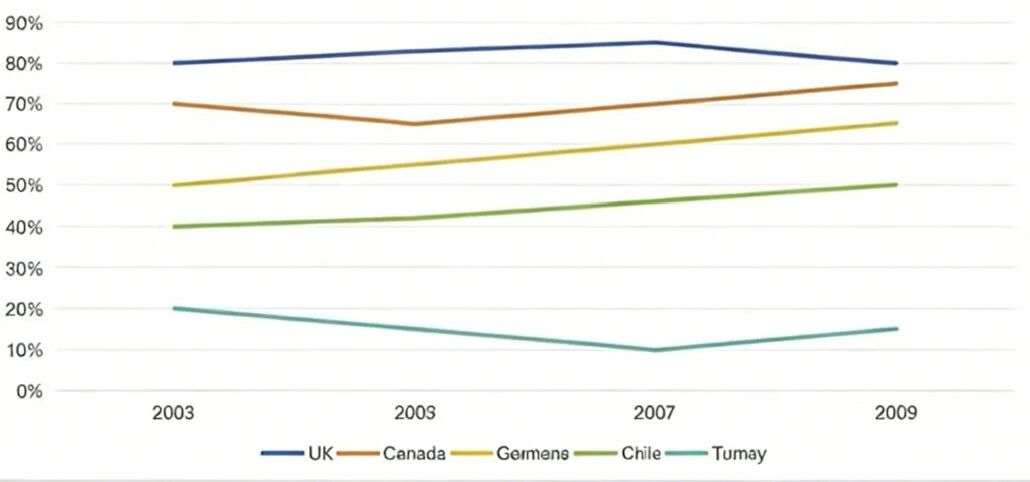
点评
这个题目要求描述五个国家之间女性就业率的变化。首先,我们需要对数据图表进行分析,概括各国女性就业率的趋势变化。
答题技巧和思路:
1. 概述趋势:开始时,要简洁地描述整体趋势,例如大多数国家的女性就业率是上升的,某些国家则有下降趋势。
2. 逐年对比:可以按照年份(2003、2005、2007、2009)对各国的数据进行对比,描述每个国家的变化趋势。注意不同国家的曲线可能呈现不同的波动。
3. 国家间比较:在描述过程中,可以进行横向比较,指出哪些国家的就业率最高或最低,哪些国家的变化幅度较大。
4. 语言表达:使用准确的词汇和连接词,避免重复,保持表达简洁流畅。
5. 结构上可以采用:引言(简述图表信息)+主要趋势(整体趋势)+国家对比(细节描述)+总结。
大作文
Today more and more people like to go to untouched and unexplored natural places to travel. What are the advantages and disadvantages for these tourists and the countries?
点评
这个题目要求分析前往未开发自然景点旅游的优缺点,既要考虑游客的角度,也要从国家的角度进行探讨。
答题技巧和思路:
1. 分开讨论:可以分为两部分讨论,一部分针对游客的优缺点,另一部分针对国家的优缺点。
2. 游客的优势:提到游客能体验到原始自然美景,远离城市喧嚣,享受独特的旅游体验。游客还可能增加对环境保护的意识。
3. 游客的劣势:这些地方可能缺乏基础设施和医疗保障,存在安全风险。此外,游客可能会破坏生态环境。
4. 国家的优势:旅游业的发展可以带动经济,提升国际声誉,创造就业机会。
5. 国家的劣势:如果管理不当,过度旅游可能会导致自然资源的枯竭和环境污染,甚至影响当地居民的生活质量。
6. 结构上可以采用:引言(简述话题)+游客优缺点(两段)+国家优缺点(两段)+结论。