
400-862-8068

直击考场 | 3月7日雅思考试回忆

作者: 2026-03-16 15:40 来源:昆明编辑
收藏


01、雅思听力 Listening


本次听力考试中part1和part4比较常规,但part2和part3的审题压力较大,加上考场的心理因素,本场听力考试整体难度偏大。

Part 1 Greenview Bed and Breakfast Booking Form

【题型】:填空

点评

本部分为典型的住宿预订场景填空,整体难度适中,信息明确,但同学们需特别注意:1)地名拼写题目字母拼写准确;2)数字信息的快速反应与准确记录,尤其是混合字母与数字的代码;3)名词单复数可根据上下文辅助判断。
1.Waikato
2.0217486905
3.April 2
4.mountains
5.desk
6.fruit
7.egg
8.horses
9.DE5285401
10.cousin

(答案仅供参考,实际答案及顺序可能有变化)


Part 2 旅游介绍

【题型】:多选+配对


点评

单选题的常见干扰上需注意听清限定词及说话者的语气转折。配对题建议在审题时快速预判选项可能出现的同义替换,听音时同步笔记关键词,避免被密集信息打乱节奏。

关键词:park, attraction, history

(待回忆)


Part 3 Climate change and allergies

    【题型】:单选+配对


点评

本篇part3中单选及配对选项较长,审题时间紧张,整体听音难度较大。同学们需要在模考练习中训练审题速度和时间分配,同时听音时灵活运用笔记减轻快速反应的压力。

21.C
22.C
23.A
24.A
25.B
26.G
27.B
28.A
29.D
30.C

答案仅供参考,实际答案及顺序可能有变化


Part 4 遗址介绍

【题型】:填空


点评

本篇为历史场景,题目难度一般,答案词难度一般。同学们要确保词汇拼写准确。历史考古类话题是Part 4的高频场景,建议平时多积累相关主题词汇。


21.bay
22.birds
23.bones
24.silver
25.status
26.bowls
27.head
28.tool
29.family
30.danger

答案仅供参考,实际答案及顺序可能有变化


02、雅思阅读 Reading


这场雅思阅读考试堪称一部“跨界大片”——从澳洲大陆的生物入侵,到大脑内部的能量博弈,再到职场人的生存挣扎,横跨生态学、心理学和社会学三大领域!三篇文章看似八竿子打不着,实则都在讲同一件事:平衡有多难!题型搭配均为“基础题型+匹配类题型”的经典组合,完全贴合官方出题规律。细节题占比超60%,判断题和填空题是得分核心,匹配题侧重考查信息检索与逻辑关联能力,对平行阅读法的运用要求较高。话题兼具知识性与趣味性,考生只要熟悉高频场景词汇、掌握题型技巧,就能较好应对。

Pasasage 1 关于外来物种对澳大利亚动植物的破坏性影响

【难度】:3星                  

【题型】:判断题(5)+填空题(8)

【类别】:生物与环境                   

  
1-6 判断 1 F  2 F  3 NG  4 F  5 T  6 NG   7-13 填空 7 fences  8 drought  9 railways  10 crops  11 rabbits 12 birds  13 predators 

(答案仅供参考,实际答案及顺序可能有变化)


点评

概述:外来物种的“澳洲历险记”这篇文章简直就是一部澳大利亚版的“生物入侵者”灾难大片!

题型组合:当“判断题”遇上“填空题”的黄金搭档

6道判断题+ 7道填空题——这是雅思阅读中最经典的“基础题套餐”,稳稳占据P1的C位!这套P1简直是“反套路”教科书——判断题里TRUE少得可怜,FALSE和NOT GIVEN唱主角,专门治那些“看到啥都选TRUE”的急性子!填空题则体贴入微,所有答案都是原文原词,绝不玩同义替换的文字游戏。最妙的是,题目顺序和文章顺序完美重合,只要按图索骥,拿分如探囊取物!

高分策略:“先填空,后判断,平行阅读别掉队!” 填空题定位词明显(fences, railways, rabbits都是大写/斜体/特殊名词),先扫荡填空题稳住军心,再做判断题时已经对文章脉络心中有数。判断题遇到NOT GIVEN别纠结——文章没提就是没提,别自己脑补剧情!


Passage 2 Decision fatigue

【难度】: 4星

【题型】:段落配对题(共6题)+ 填空题(共3题)+ 特殊词配对题(共4题)

【类别】:行为心理学   


段落配对
14. E
15. B
16. G
17. F
18. C
19. D
填空
20. rational
21. tired
22. shortcuts
特殊词配对
23. A
24. A
25. C
26. B


参考文章:READING PASSAGE 2
You should spend about 20 minutes on Questions14-26, which are based on Reading Passage 2 below.
Decision Fatigue
'Decision fatigue' helps explain why ordinarily sensible people avoid making decisions or are easily persuaded to make the wrong decisions when they are tired. Yet few people are conscious of it, and researchers are only beginning to understand why it happens.
A No matter how rational people try to be, they can't make decision after decision without paying a biological price. This 'decision fatigue' is different from ordinary physical fatigue. People are not conscious of being fired but nevertheless they are low on energy. The more choices one makes throughout the day, the harder it becomes for the brain, and eventually it looks for shortcuts: either to act impulsively instead of expending the energy to think through the possible results, on the ultimate energy saver: do nothing. Avoiding a decision often creates bigger problems in the long run, but for the moment it eases the mental strain.
B Decision fatigue involves a phenomenon called ego depletion, a term coined by social RFB psychologist Roy F. Baumeister. His research demonstrated that there is a finite store of mental stamina for exerting self-control. For example, when people fended off the temptation to eat freshly baked biscuits, they were then less able to resist other temptations. When they tried to resist the urge to cry during a sad movie, afterwards they gave up more quickly-on-tasks requiring self-discipline, such as working on a geometry puzzle. The experiments confirmed the 19th-century notion of willpower being like a muscle that became tired with use; something which could be conserved by avoiding temptation...
C Decision fatigue leaves people vulnerable to marketers who know how to time their sales, as Jonathan Levay demonstrated. He visited a tailor to have a suit made for his wedding and began going through the choices of fabric, buttons, and so forth, and when he got through the third pile of fabric samples. Levav recalls, "I couldn't tell the 18 choices apart anymore. After a while my only response to the tailor became, 'What do you recommend?" Levav put the experience to use in an experiment conducted at German car dealerships, where real customers had to choose among four styles of gearshift knobs, 25 configurations of the engine and gearbox, and a palette of 56 colours for the interior. As they started picking features, customers would carefully weigh the choices, but as decision fatigue set in they would start settling for the default option. By manipulating the order of the car buyers' choices, the researchers found that customers would end up paying more.
D Similarly, sweet snacks are featured prominently at cash registers at most supermarkets. With their willpower reduced after shopping, people are especially vulnerable to sweet drinks and snacks. While supermarkets figured this out a long time ago, only recently did researchers discover why, Baumeister's research team tested notion that people could build up willpower by first indulging in pleasure. They found that a delicious, thick milkshake strengthened willpower by helping people perform better than expected on their next task. However, the experiment also included a control group who drank a tasteless low-fat dairy beverage. It provided them with no pleasure, yet it produced similar improvements in self-control Baumeister concluded that even the tasteless drink had worked because the brain, like the rest of the body, derived energy from glucose, the simple sugar manufactured from all kinds of foods, including milk.
E To establish cause and effect, researchers at Baumeister's lab tried refueling the brain in experiments involving lemonade mixed either with sugar or with a diet sweetener. The sugary lemonade provided a burst of glucose, the effects of which could be observed immediately in the lab; the sugarless sweeteners tasted similar but did not contain the glucose. Again and again, the sugar restored willpower, but the artificial sweetener had no effect. The glucose would mitigate the ego depletion and sometimes completely reverse it, improving self-control and the quality of decisions: the subjects resisted irrational bias when making choices and, when making financial decisions, they were more likely to choose the better long-term strategy instead of going for a quick payoff.
F However, some brain researchers had reservations about the glucose connection. "Todd Heatherton, a pioneer of social neuroscience, believed in ego depletion but didn't see how this process could be caused simply by variations in glucose levels. To observe the process, and to see if it could be reversed by glucose, Heatherton's team recorded images of the brains of 45 people who were on a low-calorie diet as they reacted to pictures of food. Next, these dieters watched a comedy video while forcing themselves to suppress their laughter-thereby draining mental energy and inducing ego depletion. When they were again shown pictures of food, further brain scans revealed more activity in, the brain's reward centre and a decrease in the amygdala, which helps control impulses. The food's appeal, in other words, registered more strongly while impulse control weakened What surprised Heatherton was that administering glucose completely reversed the brain changes brought about by ego depletion.
Reading Passage 2 has seven sections, A-G.
Which section contains the following information?
Write the correct letter, A-G, in boxes 14-19on your answer sheet.
14 research in which two substances that tasted alike had different effects on the subjects ..............
15 an instance where controlling emotions while viewing something upsetting led to a lack of perseverance in other activities ..............
16 an explanation of why it is important to eat something before making a decision at the end of the day ..............
17 a reference to a researcher who was was not not initially convinced of the effect of glucose ..............
18 an account of research that mirrored an experience the researcher had in his personal life ..............
19 an example of how the location of products in a shop can be used to take advantage of 'decision fatigue ..............
Questions 20-22
Complete the summary below.
ChooseONE WORD ONLYfrom the passage for each answer.
Write your answers in boxes 20-22on your answer sheet.
The biological price of decision-making
Even when people attempt to be20...................... rational they experience 'decision fatigue' if they make several decisions in a row . They are not aware of how 21...................... they are, but it is increasingly møre difficult for their brains to make decisions as the day progresses. After making many decisions in one day, the brain seeks 22...................... in order to conserve energy. The person may fail to consider the consequences of their decision or not make a decision at all. Avoiding decisions reduces the immediate strain but can cause difficulties later.


(答案仅供参考,实际答案及顺序可能有变化)


点评

概述:决策疲劳—你的大脑在“摸鱼”这篇文章揭秘了一个让人“细思极恐”的事实:原来我们的大脑也会“偷懒”!当你连续做决定时,大脑表面装作很理性,背地里却在疯狂划水——效率下降不说,还偷偷走捷径做傻事。

题型组合:当“段落信息”遇上“人名观点”的“神仙打架”
6道段落细节信息匹配题+ 3道摘要填空题+ 4道人名观点匹配题(含NB)
——这套组合堪称雅思阅读的“中段位BOSS”,题型丰富度直接拉满!
高分策略:“平行阅读是爹,NB标记不能缺!”拿到题先看所有题型,圈出填空题在第一段,做题时首先扫荡第一段搞定20-22题,然后带着段落匹配题的关键词满场飞。人名匹配题遇到NB要格外小心,那个被翻两次牌子的人名一定要记牢——通常是最活跃、观点最多的那位!别忘了G段那个“决策前先吃东西”的结论,考试中途饿了一定要拿出来自我安慰一下!

Passage 3 关于work-life balance

【难度】:五星

【题型】:摘要选词填空+判断题+单选题

【类别】:心理与健康     

摘要选词填空题:

27题:workload对应“hours and what they are required to do”
28题:男性中high- and low-level workers不满(两头受气)
29题:电子科技+团队绩效要求(科技是把双刃剑)
30题:flexibility是少数好处之一(唯一的好消息)
31题:debt对应“repay loans”(还贷压力真实写照)
32题:single wage-earners家庭压力更大(一人养全家太难)
单选题:
33题:英国人有酬工作为了personal status(尊严和价值感)
34题:class概念比一些人以为的地位和作用更大(别小看阶级)
35题:雇员法律权利应由公司灵活设置(不是一刀切)
36题:权利清单可能给不全细节(清单有坑!)
判断题:
37题:YES!低收入者也该有带薪休假(三观正!)
38题:NOT GIVEN!女性更长产假?文中只提回归职场后可做part-time
39题:NO!免费育儿?文中说的是affordable(自费但负担得起)
40题:NOT GIVEN!年长者育儿压力大?虽然合理但文中没提

(答案仅供参考,实际答案及顺序可能有变化)


点评


概述:工作与生活的“拔河比赛”
这篇文章给职场人画了一幅“扎心画像”:现代职场最让人不爽的,不是老板脸色不好看,而是工作量太大!有趣的是,男性员工中,底层和高层最易不满,中层反而心态稳如泰山。科技是把双刃剑——让人随时在线待命,团队绩效要求又让人喘不过气。为数不多的好消息是:工作方式更灵活了。但别高兴太早,还贷压力和“一人养全家”的家庭模式正在偷偷榨干你的幸福感。至于带薪休假?作者态度很明确:低收入者也要有!但别指望政府包办一切——免费育儿?想得美,能“负担得起”就不错了!
题型组合:“填空选择判断”组成“铁三角”压轴出场
6道带词库的摘要填空题+ 4道单选题+ 4道判断题——P3的“黄金铁三角”阵容,难度直接拉满,稳稳守住最后一关!
高分策略:
带词库填空题:考的是“同义替换火眼金睛”
单选题:考的是“作者观点别跑偏”
判断题:考的是“原文比对抠字眼”

03、雅思写作 Writing


小作文


点评

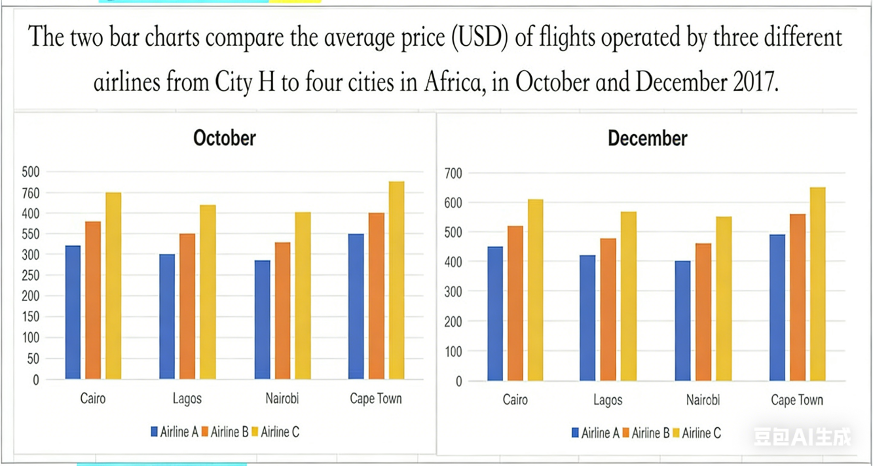
这是一道典型的雅思双柱状图静态数据题,要求对比2017 年10 月和12 月,三家航空公司从H 市飞往非洲四个城市的平均机票价格。


从数据特征看:

时间维度:12 月的整体票价普遍高于10 月,呈现明显的季节性上涨趋势。

航空公司维度:Airline C 在所有航线和月份中均保持最高票价,而Airline A 的票价通常最低。

目的地维度:飞往开普敦(Cape Town)的票价在两个月份中都处于最高水平,而内罗毕(Nairobi)的票价相对较低。


写作时建议采用“总- 分- 总”结构:先总述票价随时间和目的地变化的整体趋势,再分月份或航空公司对比关键数据,最后总结票价差异的核心规律。注意使用“significantly higher”“in contrast”等表达增强逻辑。

大作文


The best way to reduce crime by young people is to teach their parents with good parenting skills.To what extent do you agree or disagree?


点评

本题属于雅思大作文经典的同意与否类题型,话题聚焦青少年犯罪减少措施,题目带有绝对化表述“The best way”,是典型的辩证类考题,立场选择和逻辑搭建直接决定分数档次。核心议题为:提升父母育儿技能,是否为降低青少年犯罪率的最佳途径,考生需围绕该核心权衡利弊、搭建论点,切忌片面全盘同意或否定。
从题型陷阱来看,绝对化词“The best way”是高分突破口,完全同意立场极易陷入论证片面的问题,推荐选择部分同意的中立辩证立场,更符合雅思写作批判性思维要求。一方面,良好育儿技能确实至关重要,父母是孩子第一任老师,科学育儿能有效改善亲子关系、纠正孩子不良行为、树立正确价值观,从根源减少青少年因家庭关爱缺失、管教不当引发的犯罪,这是该措施的核心合理性。但另一方面,该方案绝非最优也非唯一途径,青少年犯罪还受社会环境、校园霸凌、不良网络信息、就业压力、法律意识淡薄等多重因素影响,单纯依靠家庭教育效果有限;同时,该措施见效慢、覆盖范围有限,无法解决已出现犯罪倾向的青少年问题。
高分写作思路建议:开头明确部分同意立场,主体第一段论述家庭教育的积极作用,主体第二段反驳“最佳性”,列举完善法律惩戒、加强校园教育、优化社会治理等替代措施,结尾总结家庭教育是重要手段,但需结合多方措施才能全面降低青少年犯罪率,全程紧扣话题,避免跑题,论证兼顾合理性与局限性,逻辑层层递进。
  • 精品项目
  • 品牌简介
  • 课程中心
  • 留学服务
  • 小语种
  • 校区地图
热门活动

注册/登录

+86
获取验证码

登录

+86

收不到验证码?

知道了

找回密码

+86
获取验证码
下一步

重新设置密码

为您的账号设置一个新密码

保存新密码

密码重置成功

请妥善保存您的密码
立即登录

为了确保您的帐号安全

请勿将帐号信息提供给他人/机构