
400-862-8068

直击考场 | 3月21日雅思考试回忆

作者: 2026-03-26 16:26 来源:昆明编辑
收藏


01、雅思听力 Listening


本次听力考试题型令人“大跌眼镜”,P2考查到相对较少的配对与地图组合,P3及P4更是均非以往的常规题型,这就对同学们不同题型方法的掌握提出了更高的要求。不管在哪个part出现,都要抓住相应的审题和听音要点,灵活变通。


Part 1 公园活动介绍

【题型】:填空


点评

P1场景为常规活动咨询场景,答案词也相对简单。这类常规题型要保证跟上节奏、写对拼写,为后续答题打好基础。

1.train
2.sharks
3.June
4.Africa
5.member
6.birds
7.hospital
8.movie
9.Hatton
10.6

(答案仅供参考,实际答案及顺序可能有变化)


Part 2 渡口改建

【题型】:配对+地图


点评

本篇为常规场景,而配对与地图的题型组合则较为少见。注意配对题中笔记的运用。

地图题型的基础知识点,包括常见地点单词及方位表达,需要同学们在平时足够熟悉,在考场上做到快速反应。


11.F
12.E
13.C
14.A
15.G
16.E
17.D
18.I
19.C
20.B

(答案仅供参考,实际答案及顺序可能有变化)


Part 3 教育学课程讨论(《9分达人听力真题还原及解析4》Test2 Part3原题)

    【题型】:填空


点评

本篇为《9分达人》系列原题。

题型在P3为非常规的填空题型。P3的填空题往往包含较多干扰答案,这是常规P1与P4填空不具备的特征,同学们在充分掌握填空解题方法的基础上,更要分part练习所有的题型。       
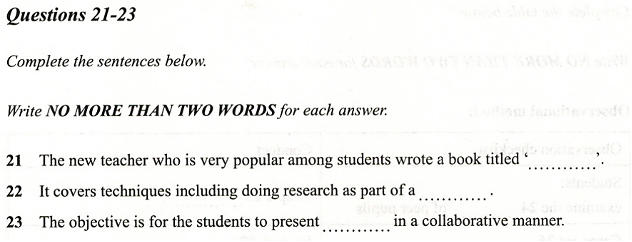
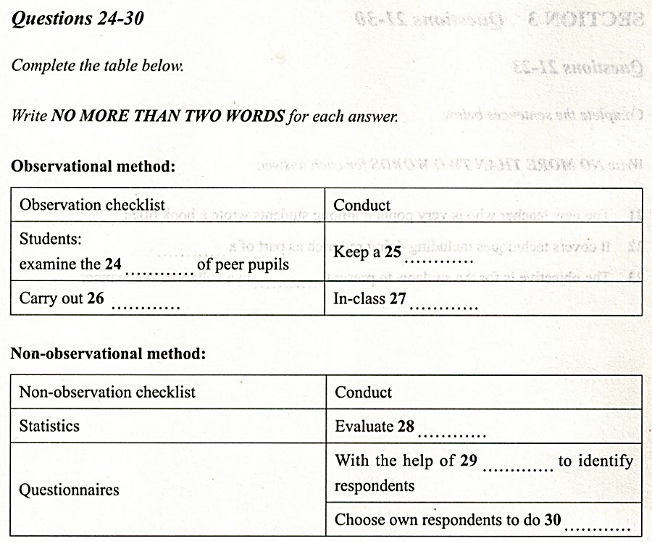
21.professional learning
22.team
23.result/results
24.behaviour(s)/behavior(s)
25.diary
26.video recording
27.simulation
28.test results
29.(the) Internet
30.interviews

答案仅供参考,实际答案及顺序可能有变化


Part 4 数字生活对年轻人的影响(《9分达人听力真题还原及解析7》Test6 Part4原题)

【题型】:单选+配对

点评       
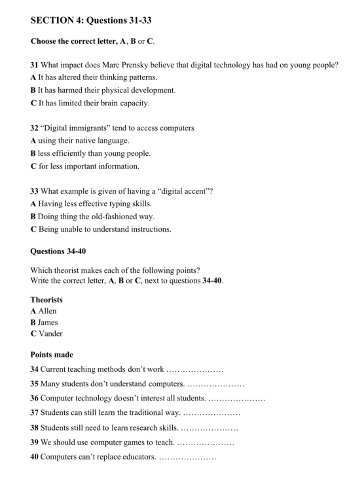
本篇为《9分达人》系列原题。
题型在P4为非常规的单选及配对题型。P4的单选及配对相对P2或P3的题目来讲干扰更少,但由于为非常规考法,同学们容易感到紧张,答题节奏容易受到影响。这种情况首先灵活运用相应题型的解题方法,再稳住心态沉着应对。


31.A
32.B
33.B
34.B
35.C
36.A
37.B
38.A
39.B
40.C

答案仅供参考,实际答案及顺序可能有变化

02、雅思阅读 Reading


2026年3月21日雅思阅读,三篇“反差萌”拉满:P1 奥尔梅克巨石头像:历史小甜点,考挖土(excavation)、运石筏(rafts)这些考古词,像玩“找词游戏”,只要背过“ruler=领导”“helmet=头饰”这类同替,稳拿分。P2 太空探索:机器人VS人类:科技辩论老熟人(参考剑20T3),考标题配对、多选、填空。套路超固定:一边夸机器人省钱高效,一边说人类能救场、会应变,最后升华“人机合作+殖民宇宙”。记住:别死磕长难句,找同替像“寻宝”,看到“cost-effective=cheaper”就冲!P3 明星员工?未必!:职场管理硬核局,考段落配对、填空、判断。颠覆认知:天才不是固定的!比如巴赫(Bach)要等标准变了才被认可,乔丹高中还被教练弃用。难点是信息散,得练“速读标段意+按题索骥”,别被“星探神话”带偏~整体:P1送分,P2套路,P3烧脑,背同替+练定位,稳了!

Pasasage 1 The Olmec and Their Great Stone Heads

【难度】:3星 (相对简单)               

【题型】:判断题(共5题)+ 填空(共7题)

【类别】:历史                                        


判断题
1. TRUE
2. NOT GIVEN
3. TRUE
4. FALSE
5. FALSE
6. NOT GIVEN
填空题
7. excavation
8. mountains
9. rafts
10. rollers
11. size
12. Helmets
13. rulers

(答案仅供参考,实际答案及顺序可能有变化)


点评

概述:概讲述了中美洲早期文明——奥尔梅克人,他们以巨型石像闻名。这些石像重达数吨,由整块玄武岩雕成,常发现于低地丛林。文章探讨了石像的来源、运输方式及用途,指出它们可能代表统治者或神祇,并用于宗教仪式。通过考古发掘、地理线索和实验重现,学者们逐步揭开了这些石像背后的历史秘密,展现了古人的工程智慧与精神信仰。
题型组合:本篇为历史类说明文,题型包含判断题与填空题。判断题考查对细节、态度与未提及信息的判断;填空题则侧重对关键名词的提取,如方法、地点、工具、特征等。这种组合既检测信息定位能力,又检验词汇掌握与理解准确性,属于典型的雅思阅读基础型搭配,难度中等。
高分策略:先速读全文抓结构与主题,再细读题目关键词。判断题中,注意区分FALSE与NOT GIVEN,避免主观推断。填空题要锁定词性,从原文找同义替换,确保拼写正确。答题时先易后难,提高时间利用率。建议结合地图、工具、特征等分类信息做笔记,提升定位速度与准确率,确保稳拿基础分。历史类文章需积累“考古术语”(如excavation, basalt, transport)和“文化类同义替换”(如“ruler”=“leader”,“helmet”=“headgear”),同时训练“矛盾点识别”能力(FALSE题的关键)。

Passage 2 Should space be explored by robots or by humans?

【难度】: 4星  (中等偏上) 

【题型】:标题主旨配对题(共6题)+ 多选题(共2题)+ 填空题(共5题)

【类别】:地理                              


标题主旨配对题
14. vi
15. iii
16. iv
17. v
18. ix
19. viii
多选题
20. A
21. D
填空题
22. infrastructure
23. spaceships
24. communication
25. laboratories
26. Colorization


READING PASSAGE 2 

You should spend about 20 minutes on Questions 28-40, which are based on Reading Passage 1 below.

Should space be explored by robots or by humans?
A The advisability of humans participating directly in space travel continues to cause many debates. There is no doubt that the presence of people on board a space vehicle makes its design much more complex and challenging, and produces a large increase in costs, since safety requirements are greatly increased, and the technology providing necessities for human passengers such as oxygen, food water must be guaranteed. Moreover, the systems required are bulky and costly, and their complexity increases for long-duration missions. Meanwhile, advances in electronics and computer science allow increasingly complex tasks to be entrusted to robots, and unmanned space probes are becoming lighter, smaller and more convenient.
B However, experience has shown that the idea of humans in space is popular with the public. Humans can also be useful; there are many cases when only direct intervention by an astronaut or cosmonaut can correct the malfunction of an automatic device. Astronauts and cosmonauts have proved that they can adapt to conditions of weightlessness and work in space without encountering too many problems, as was seen in the operations to repair and to upgrade the Hubble Space Telescope. One human characteristic which is particularly precious in space missions, and which so far is lacking in robots, is the ability to perform a great variety of tasks. In addition, robots are not good at reacting to situations they have not been specifically prepared for. This is especially important in the case of deep space missions. While, in the case of the Moon, it is possible for someone on Earth to ‘tele-operate’ a robotic device such as a probe, as the two-way link time is only a couple of seconds, on Mars the two- way link time is several minutes, so sending instructions from Earth is more difficult.
C Many of the promises of artificial intelligence are still far from being fulfilled. The construction of machines simulating human logical reasoning moves towards ever more distant dates. The more the performance of computers improves, the more we realise how difficult it is to build machines which display logical abilities. In the past it was confidently predicted that we would soon have fully automated factories in which all operations were performed without any human intervention, and forecasts of the complete substitution of workers by robots in many production areas were made. Today, these perspectives are being revised. It seems that all machines, even the smartest ones, must cooperate with humans. Rather than replacing humans, the present need appears to be for an intelligent machine capable of helping a human operator without replacing him or her. The word ‘cobot’, from ‘collaborative robot’, has been invented to designate this type.
D A similar trend is also apparent in the field of space exploration. Tasks which were in the past entrusted only to machines are now performed by human beings, sometimes with the aim of using simpler and less costly devices, sometimes to obtain better performance. In many cases, to involve a person in the control loop is a welcome simplification which may lower the cost of a mission without compromising safety. Many operations originally designed to be performed under completely automatic control can be performed more efficiently by astronauts, perhaps helped by their ‘cobots’. The human-machine relationship must evolve towards a closer collaboration.
E One way this could happen is by adopting the Mars Outposts approach, proposed by the Planetary Society. This would involve sending a number of robotic research stations to Mars, equipped with permanent communications and navigational systems. They would perform research, and establish the infrastructure needed to prepare future landing sites for the exploration of Mars by humans. It has also been suggested that in the most difficult environments, as on Venus or Jupiter, robots could be controlled by human beings located in spaceships which remain in orbit around the planet. In this case the link time for communication between humans and robots would be far less than it would be from Earth.
F But if space is to be more than a place to build automatic laboratories or set up industrial enterprises in the vicinity of our planet, the presence of humans is essential. They must learn how to voyage through space towards destinations which will be not only scientific bases but also places to live. If space is a frontier, that frontier must see the presence of people. So the aim for humankind in the future will be not just the exploration of space, but its colonisation. The result of exploring and living in space may be a deep change in the views which humankind has of itself. And this process is already under way. The images of Earth taken from the Moon in the Apollo programme have given humankind a new consciousness of its fragility, its smallness, and its unity. These impressions have triggered a realisation of the need to protect and preserve it, for it is the place in the solar system most suitable for US and above all it is the only place we have, at least for now.
Questions 28-33
Reading Passage hassix paragraphs, A-F.
Choose the correct heading for each paragraph from the list of headings below.
Write the correct number,i-ix
List of Headings
i.Robots on Earth – a re-evaluation
ii.The barriers to cooperation in space exploration
iii.Some limitations of robots in space
iv.Reduced expectations for space exploration
v.A general reconsideration of human/robot responsibilities in space
vi.Problems in using humans for space exploration
vii.The danger to humans of intelligent machines
viii.Space settlement and the development of greater self-awareness
ix.Possible examples of cooperation in space
28.Paragraph A
29. Paragraph B
30.Paragraph C
31.Paragraph D
32.Paragraph E
33. Paragraph FQuestions 34-35
According to the writer, which TWO predictions about artificial intelligence have not yet been fulfilled?
A Robots will work independently of humans.
B Robots will begin to oppose human interests,
C Robots will be used to help humans perform tasks more efficiently.
D Robots will think in the same way as humans.
E Robots will become too costly to use on space missions.
Questions 36-40
Complete the summary below. Choose ONE WORD ONLY from the passage for each answer. Write your answers in boxes 36-40 on your answer sheet.
Humans in space – the Mars Outposts approach and its implications
One way of exploring space would be through collaboration between humans and robots. For example, when exploring the planet Mars, robots could be used to set up 36____________ and do initial research before humans arrive. In other cases, humans could stay in orbiting 37____________ and give orders to robots working on the surface of the planet.
This would increase the speed of 38____________ with the robots. In such ways, robots might be used to work in space in commercial enterprises or 39____________ However, the final aim of humankind may be the 40____________ of space and this could in turn change people’s attitudes towards Earth.


(答案仅供参考,实际答案及顺序可能有变化)


点评

概述:雅思阅读最近爱考这种“人类vs 机器人”的科技辩论文,看着挺硬核,其实套路很固定:一边列机器人的好处,一边说人类的不可替代,最后升华到“合作+移民宇宙”,参考剑桥雅思20/Test 3 / Reading Passage 3 (Robots and us)。

题型组合:给段落起标题(考你抓中心思想)、多选(考细节眼力)、摘要填空(考定位和拼写)。想拿高分别死磕每词每句,先扫题干再找关键词,像玩“找茬”游戏——发现同义替换就稳了。遇到长难句就划主干,别被生词吓住。记住:这不是阅读理解考试,这是“寻宝游戏”,找到线索就能赢!

高分策略:科技类议论文需关注“观点对立结构”(如“支持机器人”vs“支持人类”的论据),并积累“科技类同义替换”(如“cost-effective”=“cheaper”,“inspire interest”=“attract attention”),同时训练“段落主旨归纳”能力(标题题的关键)。


Passage 3 We Have Star Performers

【难度】:5星(最难)                        

【题型】:段落信息配对题(6个)+填空题(3个)+判断题(5个)

【类别】:商业管理类                                          

段落信息配对题:

27. A
28. E
29. B
30. C
31. C
32. B
填空题
33. 16
34. Bach
35.(their)coaches
判断题
36. FALSE
37. NOT GIVEN
38. FALSE
39. TRUE
40. NOT GIVEN
参考文章
READING PASSAGE 3
You should spend about 20 minutes on Questions 27-40, which are based on Reading Passage 3 on pages 10 and 11.
We Have Star Performers
Most organizations are looking for talent. But what if they've got it wrong, asks Jeffrey
A One widely held assumption about talent is that it is a reasonably fixed characteristic and it is therefore the job of organizations to identify, recruit and retain star performers. This belief affects the way people are managed in the workplace. Most recruitment decisions are influenced by the skills and abilities of an individual rather than their aptitude and attitude. In terms of career development, organizations invest in staff who have been selected to reach higher-level positions, while ignoring front-line employees and people with less perceived potential. This idea, that talent is a fixed, identifiable characteristic – and that those firms with the best people do the best – is both flawed and harmful to people and organizations. There is a lot of evidence on this point, and it is useful to highlight some of the most pertinent arguments.
B First, are there stars? There is no question that in every field, from sports to computer programming to music, there are people who are better than the rest. As psychologist Dean Keith Simon, who has spent his career studying greatness, has said,'Wherever you look, the same story can be told. Identify the ten per cent who have achieved the most in a certain endeavour. Count the accomplishments they have to their credit. Now tally the accomplishments of the remaining 90 per cent. The first tally will equal or surpass the second.'For instance, in music, 16 individuals have produced about 50 per cent of the Western classical music that is performed and recorded today, while another 235 composers have produced the remaining half. The more interesting questions concern not the existence of stars, but whether these stars can be reliably identified and, even more importantly, whether their talent is a fixed aspect or can be altered.
C Identifying the best people is tricky. Quality of performance changes over time and this is true whether we are talking about professors or footballers. If performance naturally varies, any measurement taken at a single point in time, such as when someone is being hired, will have error and imprecision. Therefore, single assessments of talent are likely to contain mistakes in their categorization of people. Also, judgments about performance and ability depend on the standards used to judge what is good and bad. It should surprise no-one that for Bach to be considered a great musician, standards of music needed to change to embrace the qualities that his compositions possessed. Similarly, artists and art come in and out of fashion, which means that what is genius depends not only on a person’s ability, but on the prevailing standards used to evaluate output.
D Finally, it is difficult to evaluate people and their abilities with precision. In the domain of work, research shows that the best predictors of job performance tend to be measures of intelligence. But even these measures correlate only loosely with performance, which means that more than 80 per cent of the variation in performance is unexplained by even the best predictors. Even in the sports arena, where one would think natural ability would be readily assessed because sports teams spend lots of resources on identifying talent, mistakes get made. Basketball star Michael Jordan was dropped by his high-school basketball coach and a number of top American football quarterbacks were available early in their careers because they were not considered good enough by various teams.
Question 27-32
Reading Passage 3 has six paragraphs, A-F.
Which paragraph contains the following information?
Write the correct letter, A-F, in boxes 27-32 on your answer sheet.
NB You may use any letter more than once
27 disagreement with the view that employing talented people enables companies to achieve top performance
28 a description of what individuals have to do on a regular basis to improve their performance
29 the evidence that exceptional talent exists in all areas of life
30 how different ways of evaluating achievement at work can cause different reactions in employees
31 the belief that the time when an assessment is carried out affects its accuracy
32 the extent to which different talented individuals have contributed to their particular area of achievement


(答案仅供参考,实际答案及顺序可能有变化)


点评

概述:典型的职场与管理类学术讨论,语言难度较高,逻辑严密,涉及心理学、音乐、体育等多领域例证。文章围绕“人才是否固定且可识别”展开批判性分析,挑战传统用人观念。题目整体难度评级为五星级,考查考生对细节信息的定位与跨段理解能力。段落信息配对题占比大,且需反复回文定位;填空题与判断题则考查对数据、专有名词及逻辑判断的掌握。

题型组合:段落信息配对题(6题)信息分布广,常需跨段查找,且答案可能重复段落,要求考生对每段主旨和细节有全面把握。填空题(3题)侧重具体数据、人名、概念等细节,需准确定位并理解原句结构。判断题(5题)包含TRUE/FALSE/NOT GIVEN,需辨别文中明确信息、错误信息和未提及信息,对逻辑判断要求高。此组合既考查宏观结构理解,又检测微观信息捕捉,对时间分配与信息筛选能力是极大挑战。
高分策略:先速读标段意,再按“段落信息配对→填空→判断”顺序做。配对题抓题干关键词定位,用同义替换确认;填空盯数字、人名、名词;判断用三步法比逻辑,不靠常识。限时练平行阅读,积累替换词,保准又快又准。


03、雅思写作 Writing


小作文

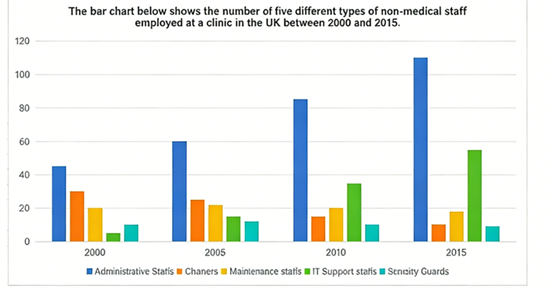
The bar chart below shows the number of five different types of non-medical staff employed at a clinic in the UK between 2000 and 2015. 


点评

1.题目核心信息 本题为动态柱状图,属于雅思小作文经典题型。图表展示了2000-2015 年英国某诊所5 类非医疗岗位(行政人员、保洁、维修、IT 支持、安保)的员工数量变化,核心考察数据趋势对比、分类描述、逻辑衔接能力。
2.审题要点 时间维度:2000-2015 年为过去时间,全文需使用一般过去时;描述趋势时用现在分词结构(如rising, declining)做伴随状语。数据分类:5 个岗位呈现3 类趋势:① 显著增长(行政、IT 支持);② 持续下降(保洁、安保);③ 小幅波动(维修),需按趋势分组描述,避免逐点罗列。高分逻辑:开头段改写题目,总述段点明“整体员工数增长、各岗位趋势分化”,主体段按趋势分组,对比极值(行政岗2015 年、IT 岗增速最快、保洁岗降幅)与特殊数据(维修岗2005 年峰值),结尾段无需额外总结,保证结构完整。
3.写作难点 需区分“持续增长/ 下降、波动、稳定” 等趋势表达,同时通过对比衔接词(in contrast, on the other hand)强化逻辑,避免数据堆砌,符合7 分+ 评分标准。

大作文


Some people say that historical sites should be completely closed while others say that historical sites should be open for the public to visit. Discuss both views and give your opinion.


点评

本题属于双边讨论+ 个人观点类议论文,话题围绕历史遗迹是否应对公众开放。正方认为应完全关闭,核心理由是保护:大量游客会造成人为破坏、环境污染,加速建筑与文物损耗;关闭可减少维护压力,更好地留存文化遗产供后代研究。反方则支持开放参观,理由主要在教育与文化价值:公众能直观感受历史,提升文化认同与民族自豪感;同时可带动旅游经济,促进地方发展,实现文化传播。写作需先分别论述两方合理之处,再给出个人立场。建议采取折中观点:历史遗址应有限度开放,通过限流、预约、规范管理兼顾保护与教育功能,这既符合文化传承需求,也能避免过度开发带来的损害。
  • 精品项目
  • 品牌简介
  • 课程中心
  • 留学服务
  • 小语种
  • 校区地图
热门活动

注册/登录

+86
获取验证码

登录

+86

收不到验证码?

知道了

找回密码

+86
获取验证码
下一步

重新设置密码

为您的账号设置一个新密码

保存新密码

密码重置成功

请妥善保存您的密码
立即登录

为了确保您的帐号安全

请勿将帐号信息提供给他人/机构