
听力整体难度:较难
本场考试Part 1为旅游咨询类填空题,Part 2为美术馆参观(选择题+地图题),Part 3为讨论笔记学习细节(选择题),Part 4为非洲部落游牧话题(填空题)。Part 2出现了地图题,Part 4涉及transhumance(季节性游牧)这一学术性较强的话题,对考生的词汇储备和听音捕捉能力要求较高。Part 1和Part 4均为填空题,Part 2和Part 3为选择题组合,整体题型分布较为常规,但部分答案词和话题词汇具有一定挑战性。
Part 1 Inquiry About a Trip 旅游咨询
【题型】:填空10
点评
1. Phone number: 07958477222
2. The best time to call: Thursday morning
3. Number of people :7
4. Departure date: 22 November
5. Purpose of the trip: wedding
6. Special requirement: one passenger can not eat cheese
7. The country visited recently: India
8. The purpose of the most recent overseas trip: business
9. Online comments: too slow
10. E-mail: carters@speedtech.com
(答案仅供参考,实际答案与顺序可能有变化)
Part 2 Art Museum Tour 美术馆参观
【题型】:单选5+地图匹配5
点评
本场考试Part 2题型为单选题和地图匹配题的组合,整体难度中等偏上。地图题要求考生具备良好的方位感和快速定位能力,需熟悉常见的方位词(如corner, opposite, next to, between等)。单选题涉及时间、历史背景、资金来源、开放项目及参观须知等细节信息,对审题速度和同义替换的敏感度要求较高。备考时可重点关注艺术类话题词汇(如sculpture, textile, gallery等),并加强地图题的专项训练。剑雅16 Test2 Part2、剑雅12 Test8 Part2、剑雅14 Test2 Part2、C20 Test 1 Part2、有地图题或艺术类话题的练习,可供同学们参考。
Questions 11--15 Multiple choices
11. When was this art gallery open to the public: C (1888)
12. The owner of the art gallery wanted it to be: A (textile factory)
13. The biggest capital funded by: B (local government)
14. What will be open to public? B (Sculpture garden)
15. Visitor's attention? B (tickets should be used in a certain time)
Questions 16--20 Map Matching
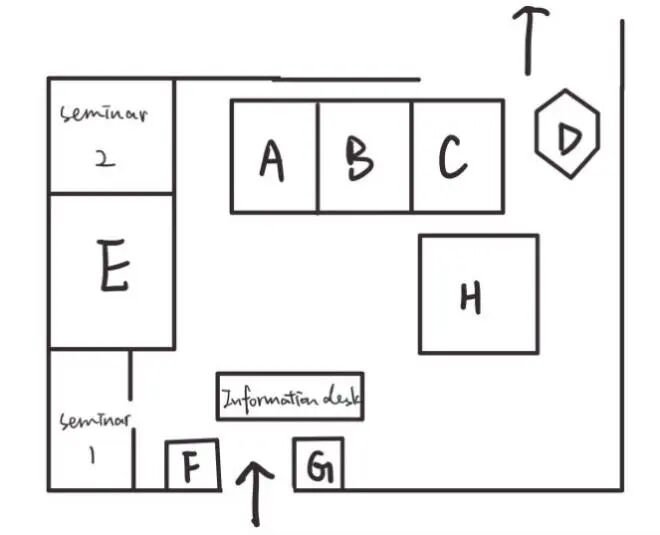
16. Media Room —E
17. Tea House —A
18. The Web Room —B
19. Café —C
20. A shop —D
(答案仅供参考,实际答案与顺序可能有变化)
Part 3 讨论学习笔记
【题型】:单选10
点评
本场考试Part 3题型为10道单选题,话题围绕学术讨论(笔记学习方法/细节)展开,属于典型的学术场景对话。长难选项的单选题对看题速度和获取关键信息的能力要求较高,考生需在有限的审题时间内快速梳理选项差异,并在听音过程中准确捕捉说话者的观点、态度及细节信息。备考时需关注Part 3常考考点,如人称考点(区分不同说话者的观点)、感情色彩判断、同义替换等技巧。剑雅20 Test1 Part3、剑雅20 Test4 Part3、剑雅18 Test1 Part3均为学术讨论类单选题组合,可供同学们参考练习。
21. B
22. C
23. A
24. A
25. C
26. B
27. A
28. D
29. C
30. D
Part 4 Transhumance 非洲部落的季节性游牧
【题型】:填空10
点评
本场考试Part 4难度较大,话题为transhumance(季节性游牧),涉及人类学/地理学领域的学术内容,介绍了非洲部落(如Gabra people)的两种游牧方式:fixed transhumance(固定季节性游牧)和nomadic transhumance(完全游牧)。答案词整体难度不低,包括vertical、cabin、portable、intermediate等学术性较强的词汇,且需注意单复数(如tents)和词性搭配。备考时需加强对学术类话题词汇的积累,尤其是人类学、地理学相关术语。剑雅18 Test4 Part4、剑雅18 Test2 Part4、剑雅17 Test1 Part4、剑雅17 Test4 Part4、剑雅15 Test3 Part4也是历史/人类学类的长句填空题目,可供同学们参考练习。
Questions 31-40
Complete the notes below.
Two types of Transhumance
- fixed: mainly in countries with predictable seasons, e.g. Switzerland
- nomadic: in areas with unpredictable climatic conditions, e.g. Somalia
Study on the Movement of Pastoralists
- for fixed transhumance, the pattern of movement is described as 31. vertical
- while for nomadic transhumance, the pattern is more complex and varied
Differences in terms of homes
- fixed transhumance live in a semi-permanent shelter on high ground such as 32. cabin
- nomadic transhumance always stay in portable shelters, e.g. homes of the Gabra people carried on 33. camel
Number of people involved
- for fixed transhumance, only 34. tents pastoralists make the journey
- however, all nomadic transhumance migrate with their livestock
Diet and Goods
- people who do not leave the valleys may become 35. portable
- exchange animals with other communities for 36. young
- herds provide all needs-food and 37. grain
Research in Algeria in North Africa
- they traditionally arrive in time to help local residents with the 38. clothing
- their homes are 39. food which are temporary shelters
- a better term to describe this type of transhumance might be 40. intermediate
(答案仅供参考,实际答案及顺序可能有变化)

02、雅思阅读 Reading
本周阅读作为中国大陆雅思纸笔考试最后一战,依旧没有选择温柔收场。烤鸭们本想和纸笔体面告别,没想到临走之前还要再挨阅读一刀:P2四组多选轮番出手,人名观点匹配紧随其后;选项看着都对,答案就是难留,观点绕来绕去,定位反复回头。好不容易熬到P3,人名观点再次抬头,段落信息匹配继续补刀;人名一个接一个,段落一篇接一篇,时间一路暴走,心态逐渐失守。 今天的题再次提醒大家,多选不能只靠原词碰头,匹配更要锁定细节特征,别一上头就全文来回游。单词基础要守住,同义替换要看透,定位范围要缩小,做题节奏更要稳住,才能少在选项里停留,多把正确答案带走。 而从今天以后,纸笔阅读正式退休,答题卡今天挥手,阅读之路还没到头,下一站——机考继续战斗!相关话题文章已经附在下面喽,那就和小航一起来看看今天的纸笔阅读考情回顾吧~
Passage 1: 关于婚礼蛋糕的历史 The History of cakes at Weddings
【难度】:⭐⭐⭐
【题型】:判断+填空
【类别】:文化+历史
In Western cultures, since antiquity. Weddings customarily have been celebrated with a special cake. Ancient Roman wedding ceremonies were finalized by breaking a cake of wheat or barley over the bride's head as a symbol of good fortune. The newly married couple then ate some of the crumbs together. Afterward, the wedding guests gathered up the remaining crumbs as tokens of good luck. Wedding guests were also supplied with sweetmeats called confetti, a sweet mixture of nuts, dried fruit and honeyed almonds. Handfuls of confetti were showered over the bride and groom; indeed, it seems to have been the custom to throw confetti about enthusiastically. Eventually, confetti in the form of sweets and nuts was replaced with rice, flower petals, or colored paper, and these new types of confetti continue to be thrown over newly married couples in many countries around the world.
When the Romans invaded Britain in 43 AD, many of their customs and traditions became part of British life. These customs included their wedding customs, and when the Normans invaded Britain in 1066 they brought many French traditions. Other changes came about due to increased trade and contact with Europe, but present- day British wedding traditions remain firmly rooted in the past. In medieval Britain, small spiced buns, which were common everyday fare, were often eaten at weddings. These were stacked in a towering pile, as high as possible. If the bride and groom were able to kiss over the tall stack, it augured a lifetime of riches. The earliest British recipe exclusively for eating at weddings is Bride Pie, which was recorded in 1685. This was a large round pie with an elaborately decorated pastry crust that concealed a filling of oysters, pine nuts lamb and spices. Each guest had to eat a small piece of the pier not to do so was considered extremely impolite. A ring was traditionally placed in the pie, and the lady who found it would be next to marry.
In the 17th century, Bride Pie was changed into Bride Cake, the predecessor of the modern British wedding cake. Cakes containing dried fruit and sugar, symbols of prosperity, gradually became the centerpieces for weddings. Some people made Bride Cake in the cheaper form of two large rounds of pastry sandwiched together with currants and sprinkled with sugar. Very few homes at the time could boast of having ovens, but this type of pastry cake could be cooked on a baking stone on the hearth.
Later in the 17th century, there was a new development when wedding cakes began to be made in pairs, one for the bride and another for the groom. Both cakes were dark, heavy fruitcakes; the groom's cake was often the smaller of the two, and was divided among the unmarried male guests. In addition, the bride's cake was distributed among the women. However, as the bride cake was usually the more ornate of the two, it became more popular and gradually became the only cake served. Moreover, during the 17th century, a French chef had the idea of covering the cake with icing, which reflected the whiteness of the bride's dress and also represented her purity. This style of cake became known as the 'white cake'.
Wedding cakes became increasingly elaborate in the 19th century. Queen Victoria's wedding cake, for example, was over three metres in circumference and weighed 136 kilograms. It had an ornate icing design and was decorated with figures of Britannia, the Prince and the Queen. Wedding cakes had to be constructed in tiers because they were so large, and the tiered cakes were held up with pillars. The wedding cake that we know today, with its different tiers of varying sizes, evolved from this period. This design is sometimes attributed to a baker called Thomas Rich, but there is evidence that a similar design was used earlier for other special cakes. After the Second World War, when ingredients were no longer rationed, wedding cakes became even more elaborate, with pillars and figurines representing the bride and groom. They were also often iced with white icing, and for this reason the wedding cake is sometimes still known as the 'white cake' in Britain, although modern couples often choose alternative colours for their icing.
(答案仅供参考,实际答案及顺序可能有变化)
点评
Passage 2 关于组织设计的早期方法 Early Approaches to Organisational Design
【难度】: ⭐⭐⭐⭐
【题型】:多选+人名观点匹配
【类别】:商业管理
参考文章
Early Approaches to organisational design: A review of the classical and neoclassical theories of organisational structures
Determining the 'best' type of organisational structure for a particular situation has long been an important task for managers in all types of organisations. All structures have advantages and disadvantages and managers like the challenge of developing the most appropriate design for changing circumstances.
The Classical Approach
Early management writers attempted to approach organisational design using a set of principles that would make an organisational structure perform efficiently in most situations, independent of external conditions and internal objectives. The sociologist Max Weber and management writers Frederick Taylor and Henri Fayol were major contributors to this so- called classical approach. They believed that the most efficient organisations had a legalised formal and hierarchical structure called a 'bureaucracy'. Members of the organisation were guided by a sense of duty to the organisation and by a set of rational rules and regulations. According to Weber, such organisations were characterised by the specialisation of tasks, appointment by merit, and an impersonal climate.
Today the word 'bureaucracy' sometimes has negative connotations. Early management writers, however, commended bureaucracy as an organisational design for its rationality, rules for decision- making, clear chain of command, and promotion of people based on ability and experience, rather than favouritism or whim. Weber also believed that clearly specified authority and responsibility made performance easier to evaluate and reward.
Criticism of the Classical Approach
Weber, Taylor and Fayol developed their theories when organisations that resembled this bureaucratic model were modern and efficient. It became evident, however, that some of the major advantages of the bureaucratic structure could become disadvantages if the theory were applied dogmatically. For example, the safeguards against favouritism could be rigidly imposed by adhering excessively to rules- resulting in both managers and subordinates becoming depersonalised.
The classical approach has been criticised from two major perspectives. First, the theory may not have a basis in reality. Have organisations like those described by Weber and the others ever existed? Second, it claims that organisations designed and managed according to bureaucratic principles will enjoy the predicted benefits. But critics argue that the world no longer fits the assumptions in Weber's model (if it ever did), and so a bureaucracy might not yield beneficial results.
Early human relations researchers and behavioural scientists attempted to deal with the major inadequacy of the classical bureaucratic model: neglect of the human element. They argued that an industrial organisation has two objectives: economic effectiveness and employee satisfaction. They also wrote that the bureaucratic structure could be improved by permitting more subordinate participation in decision- making. Because these researchers tried to improve, and not reject the classical model. They are sometimes called neoclassical theorists and include Douglas McGregor, Chris Argyris and Rensis Likert.
The Neoclassical Approach
McGregor believed that the vertical division of labour that characterised bureaucratic organisations was derived from negative and false assumptions about workers which he called 'Theory X'. Managers assume lower- level employees lack ambition and need orders to work effectively. The rigid formal hierarchy is designed to maintain managers' power over subordinates. Decision- making takes place at upper levels of management while the decisions are carried out by people at lower levels. McGregor argued that organisations based instead on 'Theory Y' assumptions use their members' potential. Theory Y assumes that most people find work satisfying, commit themselves willingly to organisational goals and seek responsibility. Members have more independence than in bureaucratic organisations and lower- level participation in decision- making is encouraged.
Argyris was concerned that managers in bureaucratic organisations had near- total responsibility for controlling their subordinates' work. He argued that managerial domination makes subordinates passive and dependent, and decreases their sense of responsibility and self- control. Argyris argued for an alternative organisational design that acknowledged human needs and feelings, and increased workers' satisfaction. Like McGregor, he favoured giving subordinates more independence and decision- making power to create a more informal organisational culture.
Likert shared the perspectives of McGregor and Argyris. In his research, he found that managers who encouraged their subordinates could motivate them more than traditional authoritarian managers. Likert based on model of four possible systems on these findings. In System 1 power and authority are distributed strictly according to the classical management subordinate relationship: a manager gives orders to lower- level members. In System 4 organisations, by contrast, there is extensive participation in decision- making and problem- solving groups. Some individuals in each group also belong to other work groups to ensure communication between them. System 4 represents Likert's view of an ideal organisation.
Criticisms of the Neoclassical Approach
The neoclassical approach to organisational design compensates for limitations in the traditional classical model, but it has also been criticised. First, the neoclassicists share the classical assumption that there is one best way to design an organisation. They overlook environmental, technological, and other variables that might affect an organisation's design, and overemphasise psychological and behavioural variables. Second, Theories X and Y oversimplify human motivation and neglect individual differences. Not everyone is motivated by the non- monetary aspects of work, nor is all work satisfying. Finally, the coordination of work groups to achieve organisational goals is problematic because managers may not be able to ensure that different groups' decisions are compatible with each other.
(答案仅供参考,实际答案及顺序可能有变化)
点评
P2一上来就不打算和大家客套,四组五选二多选题轮番出手,人名观点匹配还在最后守候;选项一个比一个眼熟,答案一个比一个难留,前面刚刚排除两个,后面又觉得剩下三个都有理由。文章主要围绕组织管理中的 classical approach和 neoclassical approach展开,从Weber的bureaucracy一路讲到McGregor的Theory X和Theory Y,再到Argyris、Likert对员工需求以及决策参与的不同看法,人物多、理论多、观点更容易串台。多选题千万别靠“感觉差不多”硬凑两个,要抓住题干限定范围,再逐个验证选项;人名观点匹配则要提前把人物+观点绑在一起,别名字看了一圈,观点全都混成一团。商业文章词汇虽然冷,多选逻辑不能丢;原文证据一个个扣,才能少在五个选项里反复发愁。
Passage 3 关于昆虫启发的机器人 Insect-inspired Robots
【难度】:⭐⭐⭐⭐
【题型】:段落信息匹配+人名观点匹配+简答
【类别】:科技+生物
A. A tiny insect navigates its way across featureless salt-pans. A cockroach successfully works out how to scramble over an obstacle. The mantis shrimp scans its aquatic world through hyperspectral eyes. Using the most basic of equipment and brains tinier than a pinhead, insects constantly solve complex problems of movement, vision and navigation processing data that would challenge a supercomputer. How they do it is driving one of the most exciting new fields of technology-biomimetics and biorobotics, the imitation of insect systems to control man-made machines. Delegates at a recent conference presented some outcomes of their work in this area.
B. Dr Alex Zelinsky suggested that the method by which wasps use landmarks to find their way back to the nest may one day be part of a system for navigating cars that know where to go. A research team led by Dr Zelinsky has shown that a robot can navigate its way along 50 different landmarks by recognizing them individually using a panoramic camera. The inspiration came from biology, where wasps use a practice called turn back and look to orient themselves as they emerge from its nest. By flying to and fro, they lock in images of the nest so they can recognize it again, he explained. The robot's panoramic camera logs the surrounding area and its key landmarks, which are then sorted in its computer according to how reliable they are as navigational aids. The landmarks are then scaled, from small to large, so that the robot can recognize whether it is getting closer to or further away from them. Their location is built into a map in its mind, which operates at different scales and instructs the robot whether to turn left or right at a particular mark. The technology provides a general way for a machine to navigate an unknown landscape. The ant also has a way of measuring distance traveled, while a path integrator periodically informs the ant of its current position relative to its point of departure. Rather than integrate all the information it receives in its brain, the ant actually performs a number of complex calculations in different organs. Like a supercomputer, the ant has many separate subroutines going on simultaneously. Using the ant's ability to steer by polarised light and to store and reuse landscape images, Wehner and colleagues have built Sahabot, a small vehicle that uses polarisers and a digital CCD camera to store 3600 images of landmarks to the ones in its memory.
C. For three decades, Professor Ruediger Wehner has journeyed from Switzerland to the Sahara desert where Catalyphis, a tiny ant with a brain weighing just 0.1mg, performs acts of navigational genius when it leaves its nest, forages for food and returns successfully. Catalyphis uses polarised light, caused when air molecules scatter light, to orient and steer itself. Wehner's team found the ant has a set of specialized photoreceptors along the upper rim of its eyes that detect polarized light, while other receptors perform different navigational tasks. As the sun moves, the ant notes its direction each time it leaves the nest and updates its internal compass. Using other eye receptors it stores a snapshot' image of landmarks, close to the nest entrance in its eyes and compares this with what it sees as it returns.
D. Professor Robert Michelson had a different desert challenge - to design a flying robot that can not only navigate but also stay aloft and hover in the thin atmosphere of Mars. Drawing inspiration from insect flight, he has gone beyond nature to devise a completely new concept for a flying machine. The 'Entomopter' is sort of double- ended dragonfly whose wings beat reciprocally. Michelson says that the flapping- wing design gives the craft unusually high lift compared with a fixed- wing flyer, enabling it to fly slowly or hover in the thin Martian air- whereas a fixed- wing craft would have to move at more than 400km/h and could not stop to explore.
E. Engineer Roger Quinn and entomologist Professor Roy Ritzmann are taking their inspiration from cockroaches. According to Quinn and Ritsmann, the ability of cockroaches to run very fast over rough terrain may one day give rise to a completely new all-terrain vehicle with six-legs, or maybe even wheel-like legs call "whegs". The key to the cockroach's remarkable cross-country performance lies partly in the fact that its legs do a lot of the "thinking" without having to consult the brain. Quinn and Ritzmann are drawing on cockroach skills to create robotic walkers and control strategies that capture the remarkable capacity of these insects to traverse complex terrain and navigate safety toward goals while avoiding obstacles. The team has already designed a series of robots that run on six legs or on whegs, enabling them to handle surprisingly rugged terrain.
F. International experts believe there are tremendous opportunities biorobotics. However, delegates at the conference had differing visions for the future of the science. While some were concerned that the initial applications of biorobotics may be military, others, such as Dr barbara Webb, predicted swarms of tiny cheap insect-like robots as society's cleaners and collectors. Sonja Kleinlogel hoped the study of the hyperspectral eyes if the mantis shrimp might yield remote sensors that keep watch over the environmental health of our oceans. Several delegates were concerned about the ethical implications of biorobotics, and urged that close attention be paid to this as the science and technologies develop.
(答案仅供参考,实际答案及顺序可能有变化)
点评

03、雅思写作 Writing
小作文
点评
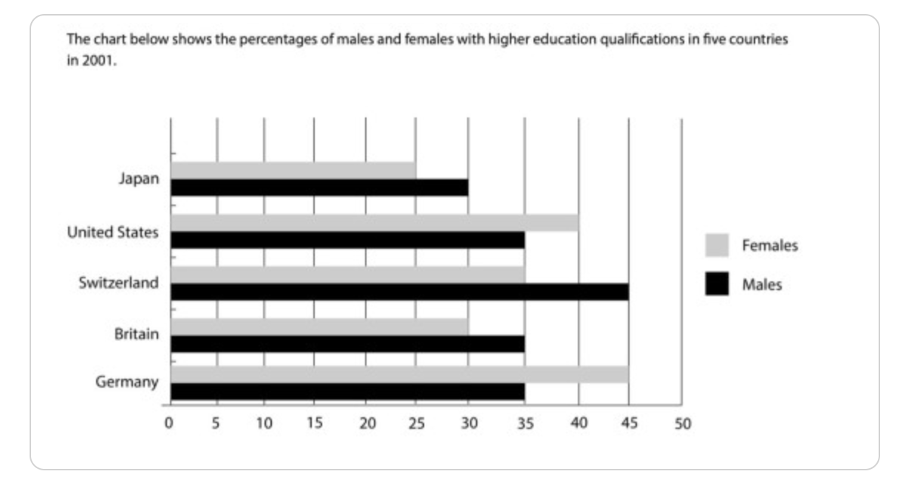
本次小作文属于静态柱图,要求考生描述“2001年五个国家中的拥有高等学历的男性和女性的比例”。从数据上来看本题的难度适中。
大作文
Task 2: Currently, many people fail to balance work with the other parts of life, what are the reasons and how to solve it?
点评