

01、雅思听力 Listening
整场考试难度呈陡坡式爬升:P1白送分→P2地图/单选中等过渡→P3、P4联手用“多人观点追踪”和“专业流程推理”卡人,对7分以下选手来说,后半场很容易连续崩盘,真正拉分的不是词汇量,而是边听边加工信息的速度和准确性。
Part 1 Holiday Accomodation Foxton Bay
【题型】:填空
点评
这篇雅思听力填空题(Section 1)总体命题难度中等偏下,属于典型的“信息捕捉型”基础题。其难度主要体现在:答案均为生活常见词汇(如heated, microwave, cinema),拼写无陷阱;数字题逻辑直接(40分钟、915英镑);且题干与原文的替换较少(如“hire”对应“rental”),多为原词重现。唯 一的潜在失分点在于第6空“milk”易被干扰信息(如coffee)带偏,但整体节奏平缓,适合基础段考生练习信息定位与拼写准确性。
Near a beach, which is beautiful and 1 ……………………
Amenities:
• a swimming pool, which can be 2 ……………………so swimmers feel comfortable
• tennis courts
• 3 …………………… hire services
Accommodation:
Self-catering cottages with:
• two bedrooms
• a kitchen with facilities such as a 4 ……………………
• a living room with TV and a collection of family 5 ……………………
• a welcome pack includes 6 …………………… tea and other beverages
Other Information:
• takes 7 …………………… minutes to drive to the nearest town
• a 8 …………………… is a five-minute drive from the holiday park
• the nearest town has:
good restaurants by the harbour
amusement parks and a 9 ……………………
Cost:
For the week beginning 22 August: 10 £ ……………………
参考答案:
1. safe
2. heated
3. bicycle
4. microwave
5. games
6. milk
7. 40
8. supermarket
9. cinema
10. 915
(答案仅供参考,实际答案及顺序可能有变化)
Part 2 Greenfields Hospital
【题型】:单选+地图
(具体答案待回忆)
Part 3 Project Comparison
【题型】:单选+多选
点评
这组题的难点在于:第一,对象要分清——对话里Dan、Oria以及可能出现的导师或第三位学生轮番发言,选项里说的是“another student”还是“their own idea”,必须精 确对应说话人,听岔一个就关联全错。第二,题干限定词很关键——比如第27-28题问的是“both groups”的共同结论,不是某一个组的发现,对话里会把两组结果分开讲,需要考生自己判断交集在哪里,原文不会直接提醒你。整体属于中高难度,拼的是边听边理清谁说了什么、题干到底在限什么范围、以及选项被翻成了什么花样。
Dan和Oria两个小组都得出的两个结论是:
如何进一步改善研究:
Part 4 Natural Rubber Production
点评
橡胶生产是工业流程,考生若缺乏背景知识,容易在动词和工具名词上迷失。审题时,对于动作链的时序预判:题干用被动语态(is poured / is pressed / are dried)勾勒线性流程,但原文会插入“then”、“next”或“after that”等时间接续词。考生需紧抓动作发生的先后逻辑。工具名词以及动作的预判:第31空“cup made of a ___ shell”中,“shell”限定材质。而33、35则是强调工业流程中的动作,且为被动语态。
‘Tapping’ — tree is cut and a layer of bark is removed
Cup (e.g. made of a 31 ______ shell) is attached to collect latex
↓
Latex is transferred to the ‘factory’
↓
Latex is poured into a 32 ______
↓
Formic acid is added to thicken the latex
↓
Rubber is 33 ______ by hand, to make it into a thin sheet
↓
Rubber sheet is put through a mangle
↓
(N.B the only 34 ______ in the process)
↓
Rubber sheets are taken to be 35 ______ in a special room
↓
Rubber sheets are purchased by 36 ______
Questions 37–40
Write NO MORE THAN TWO WORDS for each answer
HISTORY OF RUBBER
Earliest use
• 1525 — rubber 37 ______ were used in Mexico
19th century
• Key discovery — ‘vulcanisation’ made rubber stronger and 38 ______
• Increase in demand when rubber 39 ______ were invented
20th century
• Substitute for natural rubber was first developed in 40 ______ during First World War
参考答案:
31. Coconut
32. Mould
33. Pressed
34. Machinery
35. Dried
36. Traders
37. Balls
38. More elastic
39. Tires
40. Germany
(答案仅供参考,实际答案及顺序可能有变化)

02
雅思阅读
Reading
本次江浙沪原定纸笔雅思因台风全域取消,本场使用全套阅读机经旧题,三篇难度梯度区分明显,题型排布偏棘手,整体对考生做题节奏、匹配题熟练度要求偏高。虽然机经都有相似主题的篇章收录,但是P1和P3有题目上的改动,P2出现海量匹配且都有NB。错过这场考试究竟是福是祸?那就让我们详细分析一下今天阅读考题的难度如何。
Passage 1 Reef Fish Study 珊瑚海鱼研究
【难度】:⭐⭐
【题型】:判断4+流程填空3+笔记填空6
【类别】:环境
【考频】:2012.6.9/2014.10.11/2015.11.7/2019.1.5
1-4 判断
1 FALSE Modern researchers only focus on escape speed when studying how reef fish evade predators.
2 TRUE Larger predatory fish have better visual capabilities.
3.FALSE Reef fish maintain identical physical features through larval, juvenile and adult life stages.
4. NOT GIVEN Adult reef fish grow more slowly than young fish.
5-7为 流程图填空
8-13为笔记填空
参考原文:
Reef fish study
Paragraph A
For decades, marine biologists have explored how reef fish avoid being hunted by predators. Early research narrowly focused on escape speed as the sole survival advantage, yet modern studies confirm anti-predator capacity relies on multiple interrelated traits. Such characteristics include body size, escape speed, growth rate, visual acuity and body shape. Reef fish undergo dramatic physical transformations from larval to juvenile and adult phases, and individual developmental patterns differ widely across species. Tiny juvenile fish face constant threats from small crevice predators; many species like triggerfish wedge themselves into rock gaps by extending sharp spines to block attackers when resting.
Paragraph B
A popular ecological hypothesis labelled “larger is better” claims bigger fish suffer lower predation pressure. Scientists supporting this theory argue larger individuals possess superior visual development, faster swimming and stronger digestive systems. Field observations note large predators consistently target medium-sized prey rather than tiny larvae or fully mature adults. This preference for mid-size prey is linked to improved visual acuity, greater digestive capacity and sustained speed performance in mature hunters.
Paragraph C
However, controlled laboratory experiments have challenged the simple “bigger equals safer” assumption. Researchers tracked energy trade-offs for reef fish at different growth stages. Juvenile fish devote nearly all nutritional intake to rapid body expansion, while adult fish allocate energy to reproduction and daily foraging, resulting in slower overall body growth. Medium-sized reef fish face the highest mortality risk: they are too large to hide in coral micro-crevices yet too small to outswim top reef predators.
Paragraph D
Mouth size is a decisive factor separating predator and prey reef fish species. Carnivorous hunters evolve wide, elongated jaws to capture moving prey, while herbivorous reef fish such as yellow tang develop small, compact mouths to scrape algae off coral surfaces. Most reef fish remain loyal to fixed small territories where they memorise every hiding spot; schooling species travel long distances to feed but return to familiar shelter at dusk.
Paragraph E
Field data collected during new moon cycles delivers the most reliable predation statistics. Under dim lunar light, large visual predators lose their hunting advantage, so small reef fish enjoy temporary safety. Researchers contrast this with full moon conditions, when clear water visibility raises mortality rates for medium-sized fish by over 60%. Scientists conclude body size only partially determines survival, and environmental light conditions act as an equally powerful variable shaping reef fish population numbers.
(答案仅供参考,实际答案及顺序可能有变化)
点评
本次考试 P1 是多次复考的珊瑚礁鱼类相关机经旧题,文章围绕珊瑚礁鱼类的体型、视力、游动速度和被捕食风险展开论述,反驳了体型越大生存优势越强的固有假说,但考生务必留意雅思同一篇文章会设置两套不同考题,往期该篇搭配的是判断、摘要填空与表格填空,本次则为两组填空搭配判断题,两套题目出题点位、答案均不相同,大家不能仅凭过往做题记忆直接填答案,每道题都需要回到原文定位核对依据。Passage 2 Children's Comprehension of Televesion Advertising 儿童对电视广告的理解
【难度】: ⭐⭐⭐
【题型】:段匹5+人名匹配4+简答题4
【类别】:心理+广告
【考频】2024.4.28
14-18 为段匹(有NB)
14. C a description of recent innovations in TV broadcasting
15. D a mention of the main goods and services advertised to children
16. G a reference to a current limitation on television advertising aimed at children
17. D two techniques used to encourage children to watch TV commercials
18. E a type of advertisement that may make children believe the opposite of what is true
19-23 为人名匹配(有NB)
A Kunkel
B Kunkel et al
C McNeal
D Turow
E Greer et al
F Liebert et al
G Palmer & McDowell
H Geis
19. B Ads often aim to teach children that a brand is fun rather than telling them about what is being sold.
20. D Originally, children’s programmes were only broadcast when adults rarely watched TV.
21. D Children have a significant impact on what adults buy.
22. F Tests showed that children can follow information if simple words are used.
23-26为简答题
23. Young children confuse an advertisement with a single scene in a TV show.
24. What visual signals do TV stations use to separate programmes and adverts? separators
25. What marketing method uses show characters to sell goods directly? host-selling
26. Compared with programme audio, children find advert music much funnier
参考文章:
Children’s Comprehension of Television Advertising
Paragraph A
In 1874, long before television appeared, the British Parliament passed legislation to shield children from manipulative salesmen. This was one of the earliest official policies acknowledging children’s vulnerability to commercial persuasion. Remarkably, the core concerns raised back then remain relevant to modern TV advertising targeted at young audiences.
Paragraph B
Television has long been advertisers’ primary channel to reach children. Statistics show an average child views over 40,000 short TV commercials annually. Researcher McNeal (1987) calculated that under-14s make direct purchases worth $24 billion and sway family spending of $190 billion, explaining why brands invest heavily in kid-focused marketing.
Paragraph C
Multiple shifts in media culture have triggered a sharp rise in child-targeted adverts. Decades ago, children’s TV programmes only aired at times when few adults watched, such as weekend mornings (Turow, 1981). Today, kids’ content runs throughout prime time, alongside technological innovations like split-screen adverts and pop-up promotional overlays inserted mid-programme. The most heavily advertised products for children fall into four categories: sugary cereals, soft drinks, sweets and savoury snacks. Many governments now enforce restrictions banning junk food adverts during children’s viewing hours.
Paragraph D
Advertisers rely on two popular tactics to hold young viewers’ attention. The first is fantasy-filled scenes with cartoon characters and magical plots; the second is upbeat, catchy soundtracks that children find far funnier than regular programme music. A controversial technique named host-selling involves the programme’smain character directly promoting a product within the show itself, blurring the boundary between content and sales messaging.
Paragraph E
Many commercials include small-print disclaimers to balance exaggerated product claims, yet young children lack the cognitive ability to decode these warnings. Liebert’s 1977 experiment proved simple plain language helps children grasp hidden information, while complex formal terms confuse them deeply. Phrases like “balanced breakfast” featured in cereal adverts mislead kids under seven, who believe a single box of cereal meets all nutritional needs. Such carefully worded fine print creates false impressions opposite to the factual truth.
Paragraph F
Children aged four or younger cannot tell television programmes and commercials apart. When asked to describe adverts, they typically describe them as just another scene within the show. Broadcasters use visual separators, such as animated logos or colour fades, to mark the transition between content and ad breaks, yet toddlers fail to recognise these visual cues.
Paragraph G
Advertising psychologists point out that modern child-focused ads prioritise emotional appeal over factual product descriptions. Instead of listing a toy’s functions or a snack’s ingredients, marketers design adverts to link brands with joy and playfulness. Meanwhile, family shopping data confirms children act as powerful influencers over all household purchasing decisions.
Paragraph H
In summary, younger children’s limited cognitive development stops them processing commercial messages the way older children or adults do. Their inability to identify selling intent makes them far more easily influenced by TV advertising of all types.
(答案仅供参考,实际答案及顺序可能有变化)
点评
Passage 3 Design in the modern world现代设计
【难度】:⭐⭐⭐
【题型】:单选+选词填空+判断
【类别】:建筑
【考频】主题相似,具体题目不同
参考文章:
Design in the modern world
Paragraph A
Jonathan Chapman, a senior lecturer at the University of Brighton, UK, is one of a new breed of “sustainable designers”. Like many environmental researchers, he criticises the massive waste created by Western throwaway consumer culture and its severe ecological damage. His core goal is to create products that people want to retain instead of throwing away, alongside other designers developing recyclable, long-lasting goods. The waste generated by short-lived daily products is enormous.
Paragraph B
Household power tools such as electric drills illustrate this waste crisis vividly. Most buyers only use them for around ten minutes in their whole lifetime. Unused drills sit on garage shelves for years in what Chapman names “conscience time”: people feel guilty for wasting money and delay disposal, yet the items eventually end up buried in landfills for millennia. Every tool consumes vast amounts of raw materials in production, transport and processing, far exceeding the weight of the finished product itself.
Paragraph C
To explain people’s wasteful buying habits, Chapman analyses consumer psychology. People purchase goods to express personal identity and social belonging. However, mass-produced items lose unique symbolic meaning. In pre-industrial times, people made goods themselves or inherited them; handmade local crafts carried personal history and emotional bonds that modern mass merchandise cannot match. Without emotional attachment, consumers constantly chase novelty. When new items lose appeal, they purchase replacements, a phenomenon John Thackara terms the “schlock of the new”.
Paragraph D
Chapman’s solution is “emotionally durable design”. Designers should build lasting emotional connections between users and products. Worn jeans and well-loved teddy bears serve as typical examples: ageing alongside the owner creates irreplaceable personal memories, even when the item becomes worn out. Walter Stahel, a Swiss industrial expert, calls this the “teddy-bear factor”. Such emotional bonds stop consumers from discarding items easily.
Paragraph E
Tim Cooper from Sheffield Hallam University studies systemic sustainable design covering full product lifecycles from manufacturing to waste treatment. He admits sustainable design has been surprisingly slow to gain popularity, yet worsening resource shortages and environmental disasters are forcing industries to prioritise eco-friendly design reform.
Paragraph F
John Thackara points out two root causes of global environmental collapse: excessive weight of goods and fast global transport speed. Contrary to public belief, digital technology does not reduce resource consumption; it accelerates global resource metabolism and boosts overconsumption. To reverse this trend, Italian designer Manzini advocates a “multi-local society”, where all resources are produced, used and recycled locally to cut long-distance shipping waste.
Paragraph G
Future consumption patterns will shift away from ownership. Consumers will rent shared goods instead of buying rarely-used items. Manufacturers will sell products with built-in recycling and disposal plans to limit landfill waste. Sustainable design no longer focuses only on single objects, but entire social and economic systems.
(答案待回忆)
点评
本篇文章主题虽和以往高频机经(Design in the modern world)题材相近,但配套题目完全不一样,旧文主要批判一次性消费造成资源浪费,分析人们频繁更换、丢弃物品的心理,提出情感耐久设计,依靠人与物品的情感联结延长产品使用年限,还有多位学者给出行业转型、物流运输、本地循环、共享租赁等各类可持续发展方案;本篇属于标准雅思第三篇高难度文章,文中抽象学术概念繁多,不同学者观点极易混淆,单选题干扰陷阱密集,判断题还需要精 准区分 NO 与 NOT GIVEN,是考生冲 7 分的核心难点。

03
雅思写作
Writing
小作文
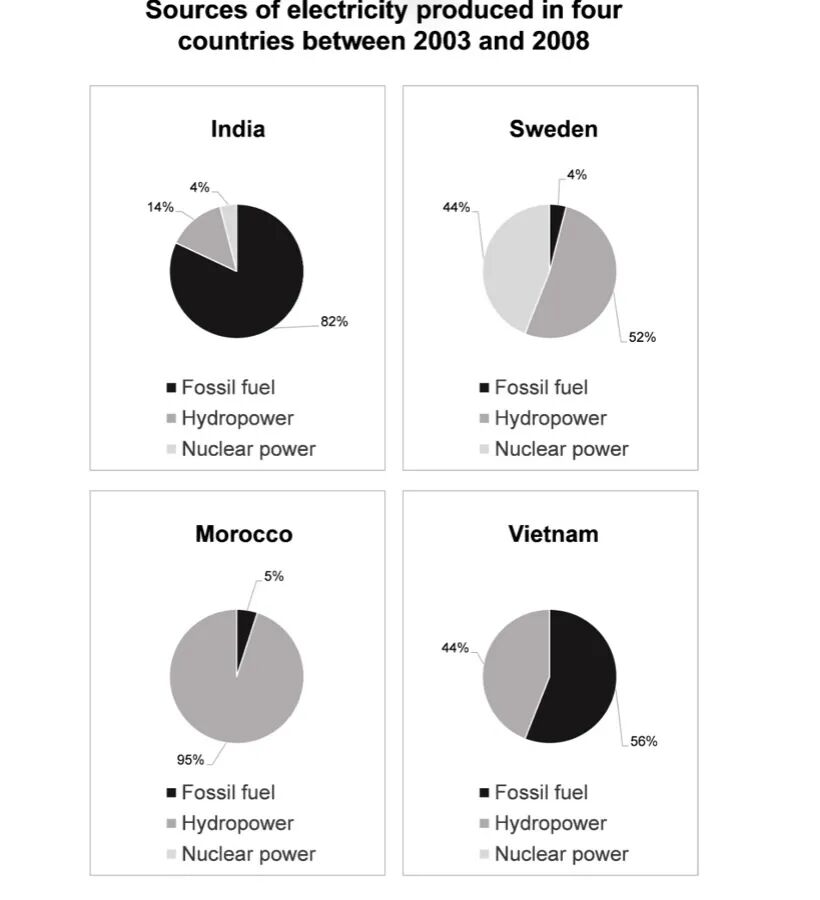
点评
今天考察的是四个静态的饼图,大家可以按照图的特点进行分组分类:
Body 1: India & Vietnam
=> 两个国家都是以fossil fuel为主要产电能源
Body 2: Sweden & Morocco
=> 两个国家都是以Hydropower为主要产电能源
Overview:
=> India和Vietnam以Fossil fuel为主,Morocco和Sweden以Hydropower为主;Nuclear在大多数国家几乎不太用得到,唯独除了Sweden是个例外。
大作文
English is now widely used as the main language of education, especially in the education systems of some non-English speaking countries. Do you think it is a positive or negative development?
英语如今被广泛用作主要教学语言,尤其是在一些非英语国家的教育体系中。你认为这是一种积极还是消极的发展?
点评
今天大作文的话题比较贴合同学们的日常,整体难度应该不算高。大家只要分析清楚英语广泛用作教学语言这件事的利弊就可以了。在立场上,同学们选择Positive或者Negative一方都可以。
优点:
缺点: