

01、雅思听力 Listening
整体难度:正常
本场考试的题型常规,语速正常,整体难度一般。Part 1为咨询场景的填空题,难度正常。Part 2 和 Part 3 都有单选题,所以同学们在备考时一定要加强单选题的练习,尤其是Part 3长难选项的单选题。本场考试 Part 4 为填空题,答案词有一定难度,所以同学们在备考时还是要加强单词的记背。
Part 1 Upper Providence Folk Festival
【题型】: 填空
点评
Part 1 基础考点考查较多,所以同学们在备考时依然要加强对月份、星期、字母和数字等考点的听力练习。此外,concert、sunscreen 容易拼写错误,headaches 要注意名词单复数的听辨,其他答案词相对简单。剑8 Test1 Part1、剑12 Test6 Part1、剑15 Test2 Part1 也是 festival 咨询场景,可供同学们参考练习。
1. June
2. 12
3. Donaldson
4. ticket
5. Thursday
6. light
7. concert
8. headaches
9. nurse
10. sunscreen
(答案仅供参考,实际答案及顺序可能有变化)
Part 2 旅游类
【题型】:单选+匹配
点评
Part 2 题型为单选题和匹配题的组合。同学们在备考 Part 2 单选题时要注意细节信息的听辨,尤其是选项信息的搭配是否正确以及完整。本场考试的匹配题需要重复选择选项,所以需要记忆的信息并不多。剑10 Test3 Part2、剑14 Test1 Part2 和 剑17 Test4 Part2 也有重复选择选项的匹配题,可供同学们参考练习。
11. C
12. A
13. B
14. A
15. B
16. C
17. A
18. B
19. B
20. A
(答案仅供参考,实际答案及顺序可能有变化)
Part 3 两个学生讨论电子废品
【题型】:单选+双选
点评
Part 3 题型为单选题和双选题的组合。同学们在备考 Part 3 选择题时除细节信息的听辨外,还要关注常考考点如人称考点的听辨,加强常用技巧如判断感情色彩的应用。剑13 Test3 Part3、剑16 Test3 Part3 和 剑18 Test1 Part3都是单选题和双选题的组合题型,可供同学们参考练习。
21. A
22. A
23. B
24. A
25. C
26. B
27-28. AE
29-30. AD
(答案仅供参考,实际答案及顺序可能有变化)
Part 4 4个英国摄影师
【题型】:填空
点评
Part 4 有一定难度,但是只用填一个答案词,所以在字数方面没有设置难度。答案词如 portraits、symbolism 和 mushrooms 较难,需要注意拼写。此外,名词单复数依然要仔细听辨。
31. portraits
32. castle
33. symbolism
34. mushrooms
35. prints
36. poet
37. focus
38. farming
39. quality
40. methods
(答案仅供参考,实际答案及顺序可能有变化)

02、雅思阅读 Reading
整体难度:中等
12月的第一场考试,阅读部分相比于上两场显得温柔许多。无论从话题还是题型搭配来看,都比较中规中矩。值得关注的是,除了基础题型,本场考试中三大类型的匹配题都有出现(占比达到14/40)。对匹配题感到棘手的小伙伴们,考前要注意复习其各自的题型特点和解题思路哦~
Pasasage 1 Australia’s Airborne Dentist
【难度】:⭐
【题型】:判断7 + 填空6
【话题】:医疗
【考频】:旧题(20180913)
点评
Passage 1 属于常见的介绍说明文,主要向我们介绍了一种特殊的澳大利亚医疗体系——皇家飞行医生服务(Royal flying doctor service, RFDS),该体系致力于为偏远地区的人群提供免费的医疗服务。题型组合,也是大家非常熟悉的填空+判断。文中所涉及的生词不多,只要稳住心态,仔细分析填空前后、认真思考判断题的逻辑,就可稳稳拿分~
判断:
1. NOT GIVEN
2. FALSE
3. NOT GIVEN
4. TRUE
5. FALSE
6. NOT GIVEN
7. TRUE
填空:
8. computers
9. space
10. dentures
11. toothpaste
12. toothbrushes
13. mouthguards
(答案仅供参考,实际答案及顺序可能有变化)
参考文章:
Australia’s Airborne Dentist
Australians living or traveling in rural and remote areas can face particular difficulties when they need medical care. Hundreds of kilometres from major cities and many hours by road from the closest hospital or clinic, some rural Australians do not have easy access to doctors, nurses and dentists.
Organisations such as the Royal Flying Doctor Service (RFDS) have been established to bring health services to outback Australian communities. The RFDs provides free medical care to people who live, work or travel in remote and regional parts of Australia.This non-profit organisation is the oldest and largest airborne health service of its kind in the world, and since 1928 it has used small aircraft to send doctors and nurses to some of Australia's most far-away communities.
In recent years, the RFDS has also started to fly dentists to regional Australia. As well as offering mobile dental clinics, the RFDS offers a range of preventative and educational services. Looking after the teeth of people in remote areas presents special challenges. These include providing care to disparate communities with no established dental facilities, and dealing with higher incidences of other diseases which are linked to, or caused by poor dental health.
People in remote areas have very infrequent visits by health staff. RFDS dentists might only visit a community once every few months, or sometimes once per year. Because of infrequent dentist visits, patients in these areas often need to put up with their dental problems before they can get treatment: consequently, people in remote areas are more likely to have tooth decay (the blackening and deterioration of teeth) and develop gum and other mouth diseases.
In some locations that the RFDS visits, there are no suitable dental facilities, so dentists have to bring everything with them. This includes drills, dentists' chairs, portable X-ray machines, and computers for keeping track of patients' treatments. Equipment can weigh up to 100 kilograms, and since the small planes that transport dentists have limited space, dentists cannot always bring everything that they need.While dentists in town or city centres can specialise in certain types of treatment, RFDS dentists need to be all-rounders'. They need to be able to do all kinds of dental procedures, as they don't have the ability to refer patients to more specialised dentists. Even with their broad experience, there are some services that are particularly challenging for RFDS dentists. For example, dentures (or artificial can be very difficult to provide, as they need to be the right shape and size for the patient, and requires many visits over a long period of time. As a result it is not practical to make dentures available.
Some chronic illnesses are more common in remote communities that in the rest ofAustralia These pesses can in turn lead to a lowered resistance to infection, includinggum and other diral infections As a result, people in outback Australian communities are more likely to experience oral health problems than city folk, and this poses extra challenges for both the dentists and the doctors of the RFDS.
Because there aren't a lot of dental services in remote areas, people living in these areas also receive less education about good dental hygiene than their city counterparts do. Australians in very remote communities might not be aware of things that people in cities take for granted, such as the importance of daily tooth brushing. Also, basic dental hygiene items such as toothpaste and toothbrushes can be more expensive in outback areas. Many people are on low incomes, meaning they have extra difficulty affording these products. If this is the case, the RFDS supplies these. As well as treating patients, RFDS dentists try to focus on preventative oral health and educate their patients on good oral hygiene, such as tooth brushing and flossing. The RFDS also provides mouthguards for young sports players. Playing contact sports, such as rugby league or Australian rules football, can damage young people's teeth, so mouthguards provide protection which prevents accidental injuries.
Adding fluoride to water supplies has been proven to reduce the incidence of tooth decay in many parts of the world. City dwellers in Australia use water supplies that have been fluoridated, and their rates of tooth decay are lower because of this. In remote areas, it is not practical to fluoridate drinking water supplies, and so people living in these areas are more subject to tooth decay. As a result, it is particularly important that people living in areas without fluoridated water pay special attention to regular brushing of their teeth with fluoridated toothpaste.
Despite many challenges, the RFDS continues to offer much-needed dental and medical support. Its presence in isolated communities greatly improves the quality of dental health, and supports important oral hygiene and health initiatives.
Passage 2 The history of the Celtic language 凯尔特语的历史
【难度】: ⭐⭐
【题型】: 段落信息匹配5 + 人名观点匹配4 + 填空4
【话题】:语言、发展史
【考频】: 新题
点评
翻开 Passage 2 ,是熟悉的味道经典的配方。首先文章话题是大家并不陌生的历史发展类,以 The history of... 开头的篇章在雅思考试中出场率极高(此前已考过wedding cake、leather、barcode、tortoise 等),放在P2的位置上,当然难逃匹配类题型的轰炸。但段落信息匹配+人名观点匹配+填空也是经典搭配。
猛猛刷过剑雅真题的小伙伴应当会发现很多类似的组合题型(如剑15 Test2 Passage2、剑17 Test2 Passage2、剑19 Test3 Passage2、剑20 Test4 Passage2等)。解题时,需要合理安排大题顺序:可优先完成定位相对简单的填空及人名匹配。最后处理段匹题时,可利用大题之间的相关性,或仔细梳理已读和未读段落,以提高解题效率。
段落信息匹配:
14. E
15. A
16. G
17. B
18. C
人名观点匹配:
19. A
20. D
21. A
22. C
填空:
23.Gaulish
23. Latin
24. Divergence
25. Irregular
(答案仅供参考,实际答案及顺序可能有变化)
参考文章:
The history of the Celtic language
[A] November 1897, in a field near the village of Coligny in eastern France, a local inhabitant unearthed two strange objects. One was an imposing statue of Mars, the Roman god of war. The other was an ancient bronze tablet. 1.5 metres wide and 1 metre high. It bore numerals in Roman but the words were in Gaulish, a version of the Celtic language spoken by the inhabitants of France before the Roman conquest in the first century BC. The tablet turned out to be one of the most important sources of words from this extinct language.
[B] Two researchers, geneticist Dr Peter Forster and linguist Dr Alfred Toth, have now used the calendar and other Celtic inscriptions to reconstruct the history of Celtic and its position in the Indo-European family of languages. They say that Celtic became a language in its own right and entered the British Isles much earlier than supposed. Then in the first century BC, the Romans defeated the Celts, both in France and in Britain, so decisively that their language. Latin, and its successor languages displaced Celtic over much of its former territory. In the British Isles, Celtic speakers survived in two main groups. the Goidelic branch of Celtic which includes Irish and Scots Gaelic, and the Brythonic branch, formed mainly of Welsh and Breton, a Celtic tongue carried to Brittany in France by emigrants from Cornwall.
[C] Because languages change so fast, historical linguists have little faith in language trees that go back more than a fey thousand years. Dr Forster has developed a new method for relating a group of languages, basing it on the tree-drawing techniques used to trace the evolutionary relationships among genes. The meted will work on just a handful of words, a fortunate circumstance since only some 30 Gaulish words have known counterparts in all the other languages under study. Dr Forster and Dr Toth have wed the method to draw up a tree relating the different branches of Celtic to one another and to other Indo-European languages like English, French, Spanish, Latin and Greek. In a published article, they say that soon after the ancestral Indo-European language arrived in Europe over 5,000 years ago. It split into different branches leading to Celtic, Latin, Greek and English. Within Celtic their tree shows that Gaulish-the mainland European version of the language separated from its Goidelic and Brythonic cousins, much as might be expected from the facts of geography.
[D] The researchers' method even dates the points at which their language tree divides, although the dates have a wide range of possibility. They calculate that the Indo-European language initially fragmented in Europe around 8100 BC, plus or minus 1,900 years, and the divergence between the mainland European and British versions of Gaelic took place in 3200 BC, plus or minus 1,500 years. These dates are much earlier than previously estimated. The traditional date of the Indo-European fragmentation has been 4000 BC for some time, said linguist Dr Merit Ruhlen. He said the new method seems pretty reasonable' and should be useful in tracing back the earlier history of the Indo-European language.
[E] Specialists have long debated which country was the homeland of the Indo-Europeans and whether their language was spread by conquest or because its speakers were the first agriculturists methods and tongue were adopted by other populations. The second theory, that it was spread by agriculture, has been advocated by archaeologist Dr Colin Renfrew. Dr Forster, who works with Dr Renfrew, said in an interview that the suggested date 8100 BC for the arrival of Indo-European in Europe does seem to vindicate Renfrew's archaeological idea that the Indo-European languages were spread by farmers. Agriculture started to arrive in Europe from the near around 6000 BC, earlier than the traditional date proposed by linguists for the spread of Indo-European This put with the lower end of Dr Forster's range of dates.
[F] Forster sad that his estimated date of 3200 BC for the afval of Celtic speakers in the British much earlier than the usual date, 600 BC posited on the basis of archaeological evidence Jean Dr Toth said their method of evaluating groups of languages against each other was similar to historical linguists, many of whom restrict the research to how words only one single language have changed over time. Asked what linguists thought of his approach he said: To be honest,they don't understand it most of them. They don't even know what I'm talking about." The method used by Dr Forster and Dr Toth has two parts. One is to draw a tree on the basis of carefully chosen words: the second is to date the splits in the tree by calibrating them with own historical This is similar to the way geneticists date their evolutionary trees by tying one or more branch branch points to known dates from the fossil record.
[G] April McMahon, a linguist at the University of Sheffield in England, said that Dr Forster's method "seems to me to be a good start', and that it was reasonable to base a language family tree on just a handful of well-chosen words. She had less confidence in the dating method, she said because language changes in an irregular way based on social factors like the size of the speaker's group and degree of contact with others.
Passage 3 Innovation in Business 企业创新
【难度】: ⭐⭐⭐
【题型】: 判断4 + 单选5 + 句子匹配5
【话题】:企业管理、心理
【考频】:新题
点评
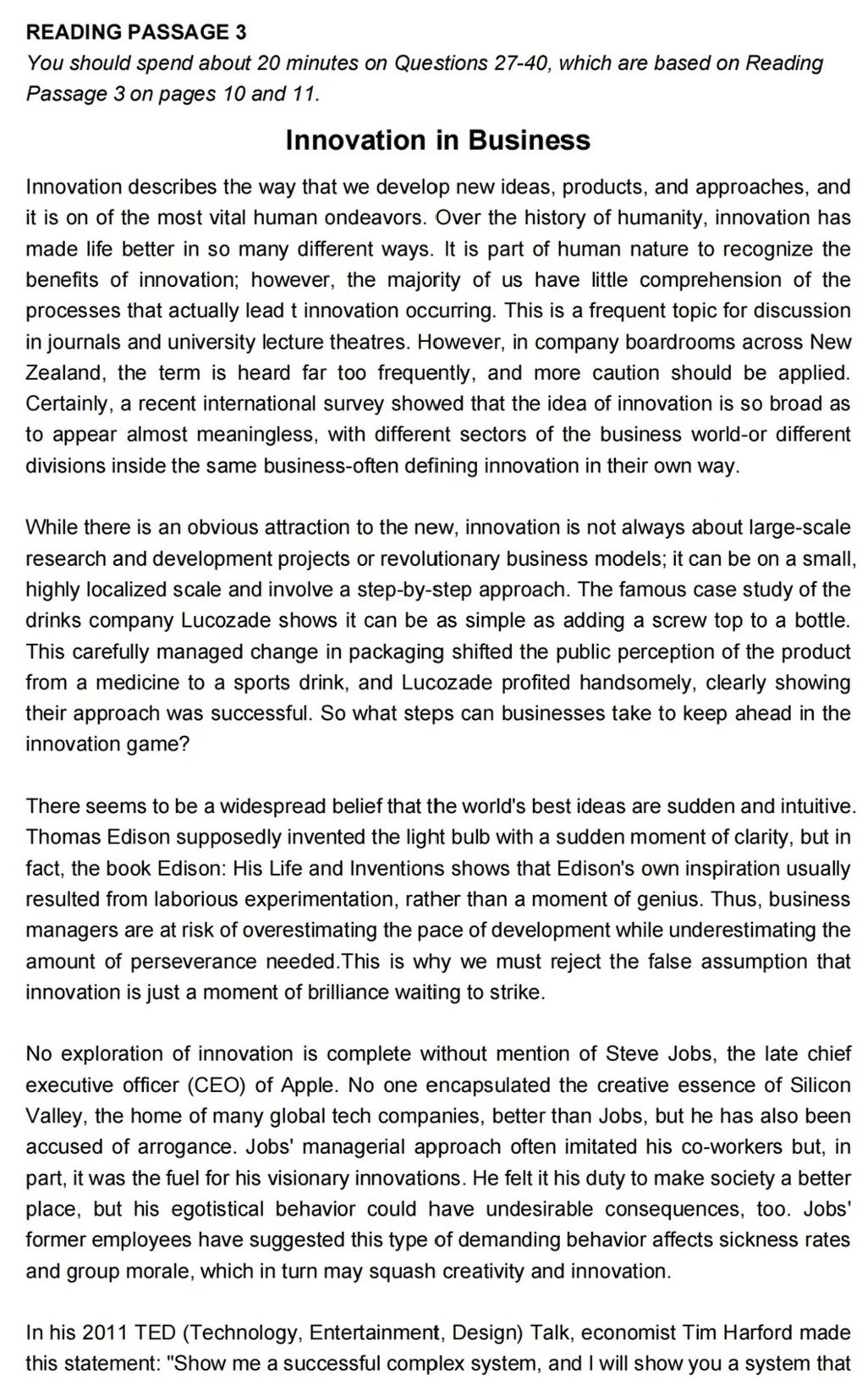
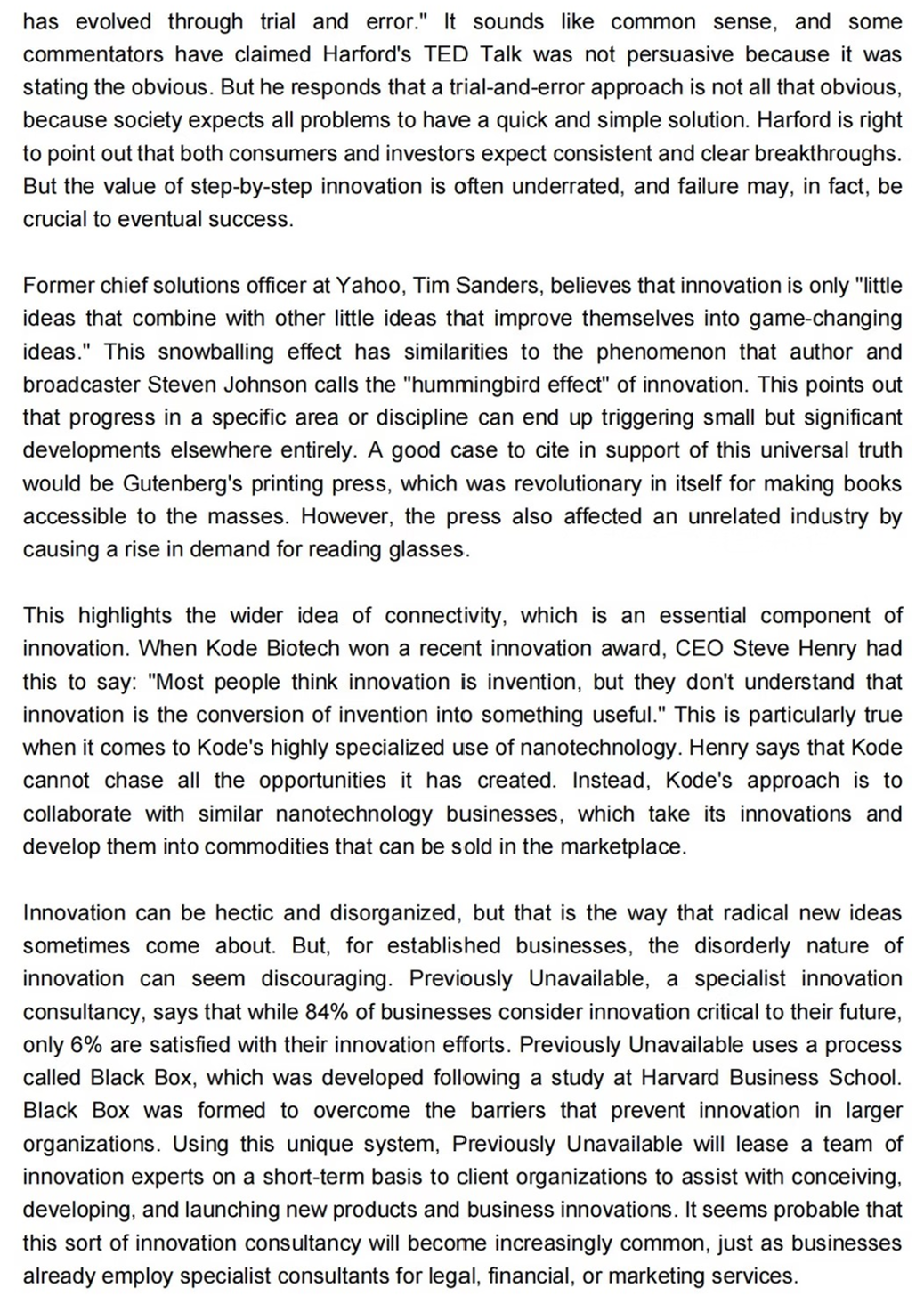
从题型搭配来看,Passage 3 仍然是单选的主场,但和单选常常勾肩搭背出现的“好兄弟”——选词填空,却被偷偷替换成了句子的首尾配对题~(犹记上一次出现句匹还是在9月27日)。时隔两个多月卷土重来,估计也让平时对此类题型练习较少的小伙伴们有些茫然,但其实该题型组合,还有高度类似的话题早在剑雅真题中出现过,大家可以参考 剑10Test1 Passage 3 The Psychology of Innovation:Why are so few companies truly innovative?进行了解。此类话题大多探讨创新的定义、创新心理如何形成、以及企业管理者如何激励员工进行创新。
考试时需注意:句子配对题大部分具有顺序性;需观察题干是否有明显定位词,如果无法定位,在原文大多会以同义替换的形式出现,可以放最后做。Passage 3 的判断普遍比较抽象、难定位,但可以搭配信息量较大的单选题一起完成。小伙伴们也要尽量预留出20-25分钟的时间,以保证能完成难度较高的 Passage 3。
判断:
27. NO
28. YES
29. YES
30. NOT GIVEN
单选:
31. C
32. B
33. D
34. A
35. D
句子匹配:
36. E
37. G
38. C
39. B
40. D
(答案仅供参考,实际答案及顺序可能有变化)
参考文章:

03、雅思写作 Writing
小作文
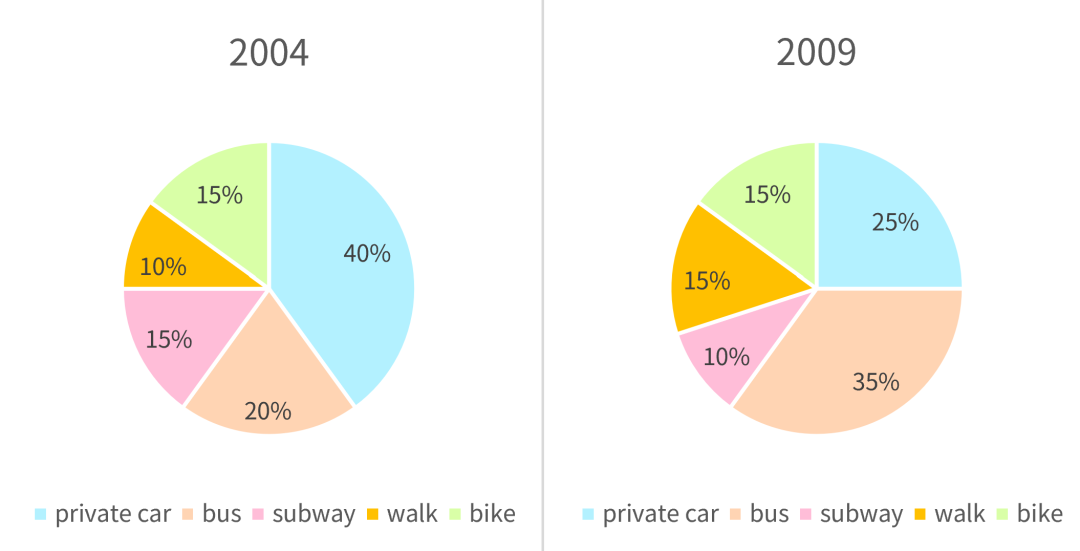
The charts below show the percentages of university students using different ways to travel to university from 2004 to 2009.
点评
试题分析:
本次小作文考察的是动态饼图。图中展示的是2004到2009各类交通使用的比例变化情况。本次小作文难度不大,需要展现趋势变化和数据特征,以及突出数据比较。
写作思路:
开头段简单改写。概述段陈述主要趋势变化。细节段可以按变化趋势分段。可以将 private car 和 subway 分到一个段落,其余分到第二段。主要描述极大值,极小值,等值和倍数关系。注意本题时态为过去式。
大作文
Companies introduce new products regularly and encourage consumers to replace their products with these new models. Do you think it is a positive or negative development?
点评
试题分析:
本次大作文考察的是利弊分析类,题目中提到的现象是:现在很多公司定期生产新产品并鼓励消费者用这些新产品替换原来的旧产品。本次考察的话题比较新颖,可能会对论点的思考造成阻碍。但是,既然题目提到公司和产品生产,不难想到可能会用上经济,科技以及创新有关的话题词条。文章结构比较简单,还是可以用立论驳论结构完成。
写作思路:
Positive的要点:
-
为持续创新带来驱动力。公司为了让更多的消费者用自己的新产品去替代旧的,需要以更加有优势的产品获得消费者青睐。这样一来,为了抢占市场份额,获得更多消费者,公司需要不断创新,让自己的产品脱颖而出。可以搭配智能手机更新换代的例子进行佐证。
-
带动产业链发展,提供更多就业岗位。首先公司生产新产品需要研发,设计,生产的工作人员。其次,广告宣传、运输物流,到商店销售、售后服务、甚至回收处理,每一个环节都需要人手。
Negative 的要点:
-
造成浪费,加剧环境危机。公司可能会通过各种营销手段说服消费者购买并使用新产品,如果更新换代很快,部分产品有可能难以拆解,最终难以做到有效回收,甚至导致大量仍有价值的资源被填埋或低效焚烧。
-
加重消费者经济负担。过快的产品更新节奏让消费者面临持续的选择压力,有可能促使他们超前消费,最终个人财政压力加剧。